A strawberry runner row can look full of promise long before it is ready to be treated as a row of future plants. One established plant may be sending runners across open soil, another young plant may only just be making its own hold, and a third may already look independent from a distance. When all of that green growth is viewed as one mass, it becomes difficult to remember which plants were meant to be watched, moved, or simply left to develop.
The useful starting point is not to count every new plant. It is to keep the line between the mother plant, the runner, and the young plant visible long enough to understand what is happening in that section of the bed. A small amount of field memory makes later selection and moving far less like sorting through a tangle.
A runner row contains more than one generation at once
In a nursery bed, established plants and younger plants often share the same narrow strip of ground. Their leaves may overlap, but their roles are not identical. Before the row fills in, take time to see where each runner begins, where it touches down, and whether the young plant can still be inspected without disturbing the rest of the line.
This is not a reason to make the row look perfectly uniform. Uneven timing is part of what a runner bed reveals. The practical question is whether a person can still tell which connection belongs to which plant. If that answer is unclear now, it will be even less clear after the foliage closes over the soil.
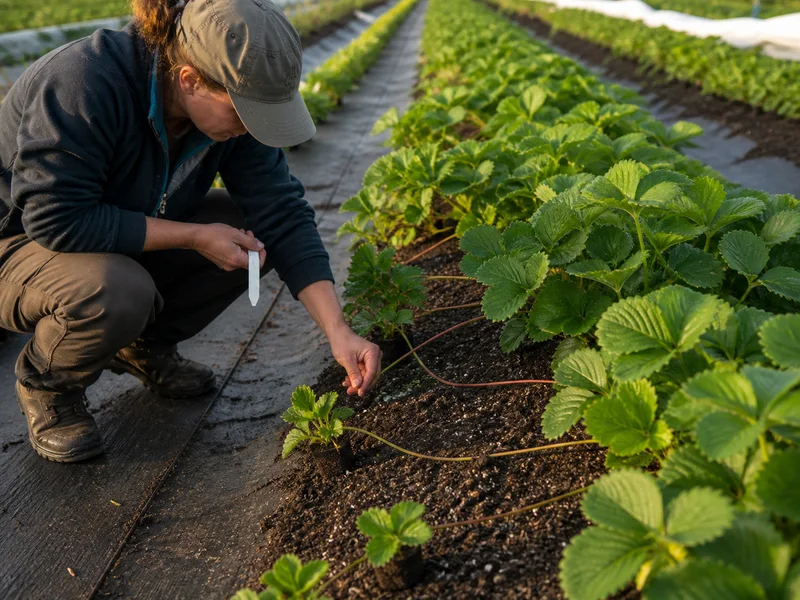
Choose a point to watch, not a label for every leaf
A simple marker, note, or repeated observation point can keep a nursery row readable without turning it into a complicated inventory. Mark a few places where the runner line is easy to follow, where a young plant is starting to establish itself, or where the bed changes from open soil to crowded foliage. These are reference points for the next walk, not a promise that every plant will follow the same timetable.
What matters is continuity. When you return, can you still find the same mother plant and the same young plant? Can you see whether the connection has changed, disappeared beneath leaves, or become easy to confuse with another one? A short answer to those questions is more useful than a generic note that the nursery looked green and healthy.
Keep the crown in the picture, not only the leaf cover
Leaves make a row look active, but they can also hide the part of a young plant that needs to remain visible for later handling. Gently looking through the row from the side often gives a better view than looking straight down from the aisle. It helps distinguish a plant that is simply leafing out from one whose place in the row can be clearly understood.
The same attention carries into transplant planning. The strawberry crown and transplant guide focuses on what should be checked before young plants move. A runner-row walk comes earlier: it preserves the context of where those young plants came from and what their immediate surroundings looked like before any choice is made.
Let the moving day begin with a memory of the row
When a nursery bed is eventually used for the next stage, its most useful record may be a few plain observations: which section stayed easy to read, where runners crossed into the path, and which young plants were easiest to revisit without shifting the row around them. These notes do not replace a plant check. They make that check more specific.
A good runner bed does not have to look still or neat. It only needs to remain understandable enough for the grower to follow one plant's story through a changing row. Keeping that story visible is a small discipline, but it gives the next decision something better than a mass of leaves to work from.