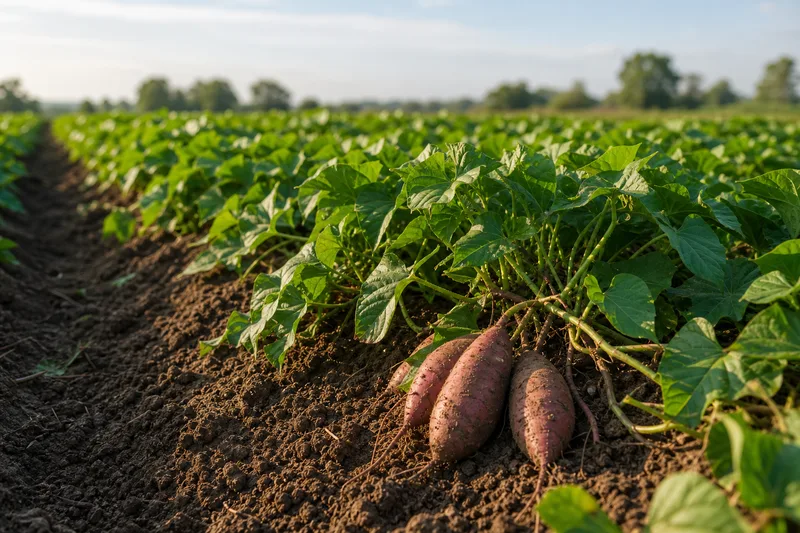
Sweet potato vines can make a field look better than it really is. A thick leaf cover may suggest strong growth, but the roots underneath can still be uneven, crowded, or slow to size. Many harvest problems begin when the canopy is judged from above and the ridge is not checked closely enough.
For slips, early recovery, and basic ridge preparation, start with the main sweet potato growing guide. This article looks later in the crop, from bulking to harvest, when vine balance, soil moisture, trial digs, and short curing decide whether the roots come out clean and useful.
Heavy vines do not always mean steady root bulking
Sweet potatoes need healthy leaves, but heavy vines alone do not prove that roots are sizing well. During the later crop, check whether ridges are still full, whether soil has cracked, and whether roots are pushing against the surface. If the row looks lush but the ridge is compacted or dry, the underground crop may not match the canopy.
When vines cover the walking space, gently lift enough growth to inspect the ridge. Avoid repeatedly flipping vines over. Rough vine handling can disturb roots and reduce the leaf arrangement that feeds bulking. This is similar to the lesson in the potato ridge guide: root crops should not be judged only by what is visible above the soil.
Bulking needs steady moisture, not sharp swings
Sweet potato roots size best when moisture is reasonably steady. A long dry spell followed by heavy watering can make growth less predictable. Soil that stays wet for too long can reduce air in the ridge and make harvest conditions worse. The goal is not constant wet soil; it is a ridge that can hold moisture and still drain.
A simple field check helps. Soil that can hold together lightly without sticking heavily is usually more workable than soil that is powder-dry or waterlogged. If ridges are cracking and pale, moisture may be short. If furrows stay wet and soil sticks to boots, drainage matters before any push for more growth.
Vine control should protect photosynthesis and access
Dense vines do not always need hard cutting. More often, the useful work is to clear walking lines, reduce tangles, and keep the crop easy to inspect. Leaves are still feeding the roots, so removing too much canopy can slow the crop at the wrong time.
If one part of the field is much more vigorous than the rest, do not assume it is the best area. Check spacing, ridge moisture, and whether the plants are putting too much growth above ground. For table roots, the aim is not the largest vine mat; it is a harvestable root set.
Trial digs beat guessing from the row
Sweet potato harvest timing should not come from planting date alone. Soil type, vine growth, moisture, and variety can all change how quickly roots finish. Before harvesting the whole area, dig a few representative plants and look at root size, shape, skin condition, and how many usable roots are forming per plant.
Do not sample only the best-looking ridge. Check a field edge, a normal center row, a low or wet spot, and any overly vigorous area. If most roots are at the target size and the weather window is favorable, waiting for a few small roots can create more risk than value.
Careful lifting and short curing protect quality
Freshly dug sweet potatoes bruise and scrape easily. Work from the side of the ridge with enough space so tools do not cut directly into the roots. After lifting, separate cut, undersized, misshapen, and clean roots before they are handled too many times.
For quick kitchen use, drying the surface may be enough. For storage, airflow, protection from rain, and avoiding deep damp piles matter more. Harvest quality is not finished when the roots leave the soil; rough handling and poor drying can undo a good crop quickly.
A practical late-season order
Check ridge shape first. Then check whether vines are blocking access. Look at soil moisture and drainage. Make a few trial digs before setting the harvest date. Finally, match harvest handling to the roots you want to keep.
The last stage of sweet potatoes is about balance. Keep the canopy working, keep the ridge readable, and let trial digs guide the harvest window instead of guessing from vine growth alone.