The first open cotton flowers change the way a field can be read. Before flowering, a crop may seem to be about height and leaf cover. Once white flowers and firm buds begin to appear on the fruiting branches, the question becomes more specific: are the plants carrying a workable sequence from lower branches upward, or are different parts of the field moving at noticeably different speeds?
This is not a moment to judge a field by its most dramatic plant. A strong-looking cotton plant at the headland can hide an uneven interior, while a single dropped bud does not explain a whole block. The more useful approach is to look at several plants in several zones and let the branch pattern tell you where a closer follow-up is needed.
Start low on the plant and work upward
Choose a few plants that represent the area rather than only the tallest ones. Begin at the lower fruiting branches, then move upward slowly. Notice which positions hold small developing structures, which have open flowers, and which are still mainly buds. The goal is not to make a perfect count; it is to understand the sequence the plant is building.
Look at the branch itself as well as what it carries. A branch that is easy to see and follow gives a clearer picture than a quick look at the top leaves. When several neighboring plants show a similar sequence, the observation is more reliable than one unusually advanced or delayed plant.
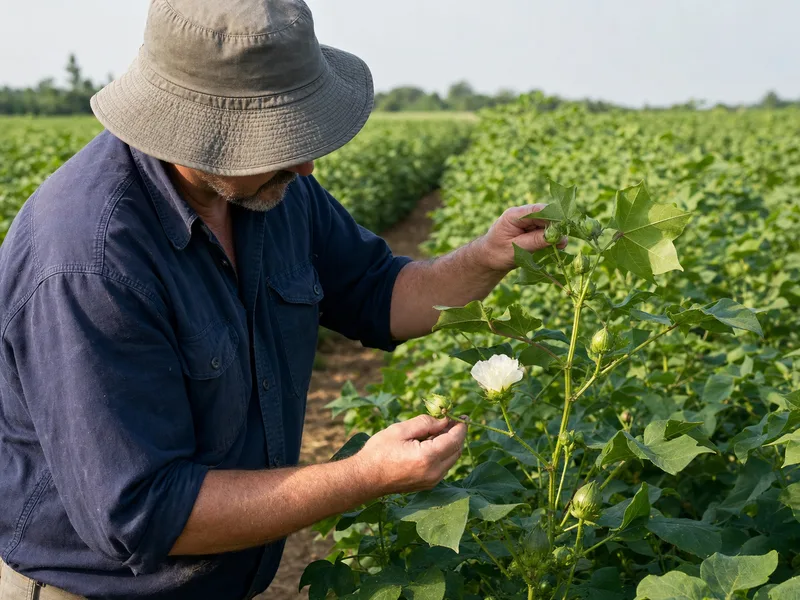
Let the flower lead you back to the nearby buds
An open flower is a useful marker because it gives the surrounding buds context. Look one or two positions below and above it rather than treating the flower as an isolated event. Are nearby buds present and well formed? Does the branch continue in a readable pattern? Is the plant carrying a balance of stages, or is one part of the sequence noticeably absent?
This kind of check is more durable than reacting to one flower or one missing position. Cotton development is not perfectly synchronized, especially across a large field. A good field note identifies where the pattern changes, then returns to that area after weather or irrigation has given the crop another chance to show its direction.
Compare field zones before calling a plant too strong or too weak
Walk from an edge into the middle, then to a part of the field with a different soil feel, traffic history, or water movement. Compare the same branch positions in each area. A difference in flowering pace may be connected to how the zone established earlier, how the surface held water, or how it responded to recent heat. The comparison matters more than attaching one label to the whole crop.
Keep the notes simple: a zone that is broadly even, a zone that is behind, and a zone that has become difficult to read because foliage or uneven growth is closing the view. This is enough to guide a useful return walk without forcing every area into the same timetable.
Use weather changes to choose the next check
Flowering-stage observations are most useful when repeated after a real change in field conditions. A hot period, rainfall, irrigation cycle, or a few days of fast growth can make branch differences easier to see. Return to the same stops and ask whether the earlier pattern is holding, narrowing, or spreading.
Avoid making a broad intervention from one brief look, especially when the change is limited to an edge or low spot. The crop is easier to manage when each decision is connected to a confirmed field pattern, not just a memorable plant.
Leave with a map for the next walk
By the end of the check, the field should be more legible: you know where flowers and buds are progressing together, where the fruiting branches need another look, and where a local condition may be shaping the crop. That map is more useful than an attempt to make every plant appear identical.
At first flower, cotton is beginning to show the structure that later carries its bolls. Reading that structure calmly, across more than one field zone, keeps the next management step grounded in what the crop is actually doing.