Sunflowers and soybeans can share a field without becoming a contest for attention, but the arrangement has to stay workable after both crops have grown into their own shapes. The tall crop changes what can be seen and reached. The lower crop fills space close to the ground. A layout that looks orderly when the field is open can feel very different once the boundary becomes a wall of leaves.
That is why the first question is not whether two crops can be placed together in theory. It is whether a person can still move along the meeting line, look into the soybean side, and tell where one crop is beginning to change the working conditions of the other. This is a field-reading exercise, not a fixed recipe for every farm.
Decide what each crop is allowed to change
A row of sunflowers brings height, shade, and a strong visual screen. Soybeans create a low canopy that can make the ground and the base of nearby plants less obvious. Neither feature is a problem on its own. The trouble begins when the tall crop makes the low crop difficult to inspect, or when the low crop closes the only line that lets someone read the space between them.
Before the canopies meet, walk the future boundary and name what it needs to remain useful for. It may be a way to compare the two sides, a route for a quick field check, or simply an open line that keeps the crop edges from becoming visually anonymous. The answer does not need to be a measurement. It needs to be a job that can still be done later in the season.
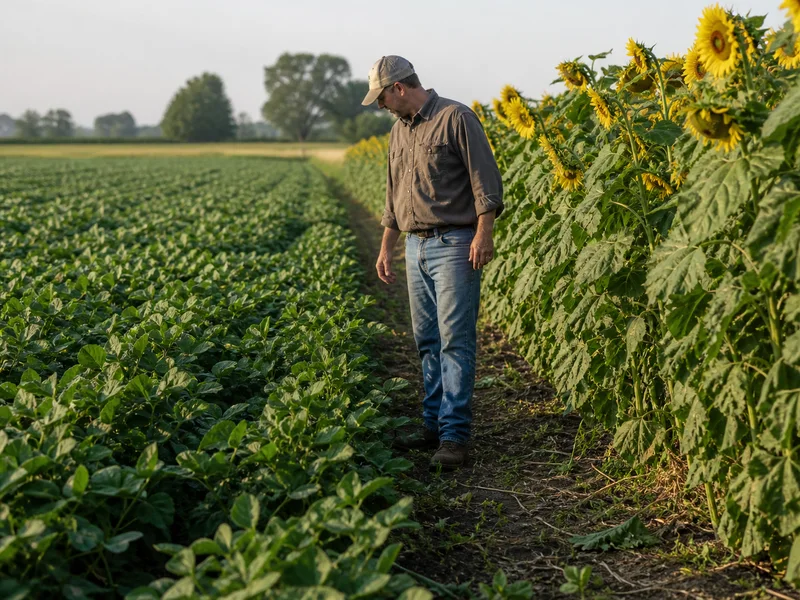
Treat the meeting line as a working zone
The space between two crops is often treated as leftover ground. In a mixed field, it deserves its own attention. Stand where the sunflowers and soybeans approach one another and look both along the line and across it. Can you still see where the soybean canopy begins? Can you step through without turning the inspection into a careful squeeze between foliage?
These are small questions, but they reveal whether the boundary is doing useful work. A field does not need a wide empty strip to be manageable. It does need a line that remains legible enough for a person to notice a change in crop height, soil surface, or access before that difference disappears inside the foliage.
Read the soybean side from more than one direction
A lower crop can look uniform from the outside even when the side beside a taller crop is telling a different story. Walk the soybean edge, then turn and look back from the sunflower side. This changes what you can see near the ground and helps separate a real field difference from an impression caused by a wall of taller leaves.
The same habit matters when soybeans move into later growth. The soybean pod-setting and canopy guide is a reminder that the crop cannot be understood from leaf cover alone. In an intercropped field, that check is more useful when the edge near the other crop is compared with an area that is easier to approach and see clearly.
Let the first season leave a better question for the next one
There is no need to judge the whole arrangement from a single walk. Keep a short note about where the boundary stayed open, where it became hard to read, and what part of the work was slowed by the relationship between the crops. That note has more value than a broad verdict that the field either worked or failed.
Heavy rain, traffic, and the way water lingers can also make one part of a field behave differently from another. A second look after changing conditions, like the one described in this corn field after heavy rain, helps keep the boundary from becoming an assumption. The next layout can then respond to a real observation: not just where the crops stood, but whether the space between them stayed usable.