At early tillering, a rice field can look evenly green from the bank while the plants are telling several different stories underneath. One corner may have settled well after planting, another may be slower because water lingers there, and a narrow strip beside the access route may be thinner simply because it was disturbed more often. The useful question is not whether every plant looks alike. It is whether the differences follow a pattern that can still be understood.
A short field walk at this stage is more valuable when it crosses more than one part of the field. Compare a strong area, an average area, and the place that concerns you most. Look at the base of several plants in each place before deciding that the whole field needs the same response.
Start with a route, not the most noticeable patch
Choose a route that takes you from the entry edge through the middle and toward a far section. Stop at a few repeatable points rather than following only the greenest or palest plants. At each stop, look for the same things: how firmly plants are settled, whether new tillers are appearing, how the leaves sit above the water, and whether the soil surface is still easy to read.
This makes a small field walk comparable from one visit to the next. A single weak patch can be real, but it does not automatically describe the rest of the field. A repeated difference across several stops is a more useful reason to look closer.
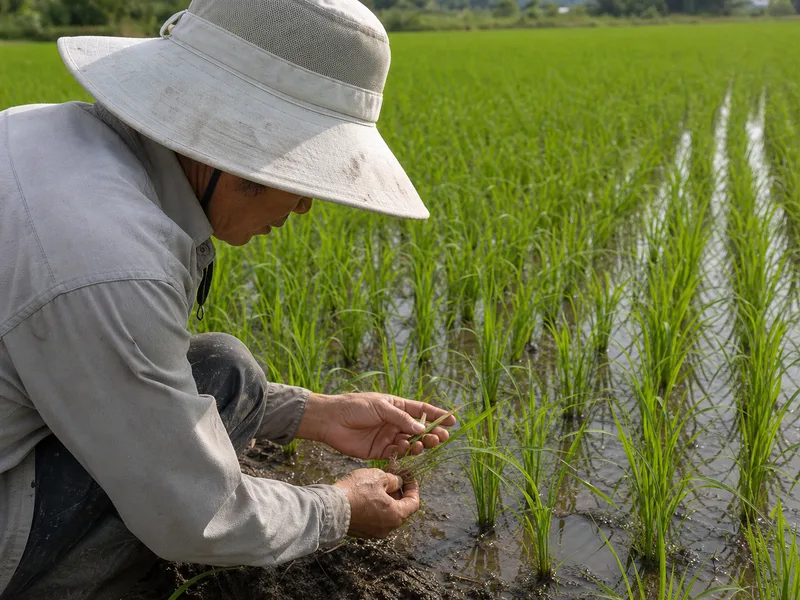
Look at the plant base before judging the top leaves
Young rice leaves can catch the eye first, especially when one area looks darker or more upright. Move a few leaves aside and look where the stems meet the soil. The base shows whether plants are standing securely, whether new shoots are beginning to separate, and whether the area around the hill is staying open enough to inspect.
Do not count every small shoot as a promise of the same outcome. Tillers develop at different rates, and their contribution depends on the crop stage, variety, field condition, and later weather. The field walk is for recognizing direction: a section that is catching up, a section that has paused, or a section where plant density is already making the ground hard to see.
Read shallow water as part of the field, not a uniform setting
Water in a paddy is rarely identical from one end to the other. On the walk, notice where it clears, where it remains still, and where a small change in level exposes or covers the plant base. Uneven water movement can help explain why one zone is advancing differently, particularly after a hot spell, rain, or a change in irrigation routine.
There is no single water depth or adjustment that belongs to every rice system. Instead, use what the field is showing you: compare the water condition with the plants at the same stop, then confirm the observation elsewhere before changing a larger area. This avoids turning a local low spot into a field-wide reaction.
Separate missing plants from a changing stand
Early in the season, open spaces are easy to notice and can make the field seem less settled than it really is. Before treating a gap as a problem on its own, look at the neighboring plants and the distribution of similar gaps nearby. A single missing plant, a compressed edge, and a broad zone with weaker establishment are different patterns and deserve different attention.
Mark the places that repeat rather than trying to correct every visual imperfection during the first walk. If the same section remains behind after a later check, the record of its water movement, soil condition, and surrounding stand will be more useful than a memory of one quick visit.
Return after a change the field can reveal
The next useful check is often after an event: irrigation, rainfall, a hot period, or a stretch of frequent field traffic. Walk the same route and compare the earlier stops. Notice whether the uneven areas are narrowing, holding, or becoming clearer. That follow-up is what turns observation into a practical management record.
A good tillering walk does not force every part of a field into the same appearance. It leaves the grower with a clearer map of where plants are settling well, where the surface or water deserves another look, and where a small local decision is more sensible than a blanket treatment.