Peanut yield can be lost quietly during flowering and pegging. The vines may look strong above ground, while the soil surface is too hard, too dry, or too shaded for pegs to enter cleanly and form pods.
The main peanut growing guide explains stand establishment, spacing, soil looseness, and full-season field checks. This article narrows the focus to the middle of the crop: flowering, pegging, early pod set, and the moisture rhythm that keeps the underground part of the crop working.
Flowering is only the start of pod set
Peanut flowers do not become marketable pods by staying above the plant. After flowering, pegs need to grow downward, reach a suitable soil layer, and continue developing underground. That is why the condition of the soil surface during this short window matters as much as the visible number of flowers.
A field with many flowers can still disappoint if the topsoil crusts, ridges dry out, or vines become so dense that air and light disappear near the base of the plant. The goal is a canopy that supports photosynthesis while still leaving the pegging zone workable.
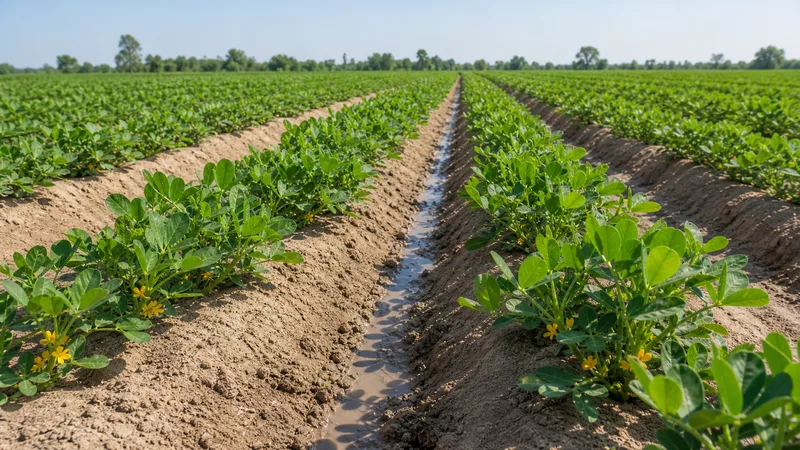
Keep the pegging layer loose but not disturbed
The soil around the plant base should be loose enough for pegs to enter without bending or drying at the surface. If the field has formed a crust after rain or irrigation, light surface loosening may be useful, but deep or rough cultivation can break roots, bury vines unevenly, or disturb young pegs.
Work near the row should be timed before pegging becomes heavy. Once many pegs are entering the soil, field operations need to be gentler. At that point, the priority is to protect what has already begun, not to reshape the bed aggressively.
Moisture should stay steady through pegging
Peanuts do not need the soil to be constantly wet, but they suffer when the pegging layer alternates between hard dryness and saturated conditions. Dry soil slows peg entry and early pod expansion. Waterlogged soil reduces air in the root zone and can leave young pods under stress.
Field checks should focus on the upper root and pegging layer rather than only the deeper soil. If the surface is powder dry while the vines still look green, pod set may already be affected. If the top layer stays sticky and sealed after watering, drainage and timing need attention before the next irrigation.
Do not let vine growth hide the row base
A strong canopy is useful only when it feeds pod development. Excessive vine growth can make the row base humid and shaded, making field checks harder and reducing airflow where pegs are forming. It can also hide uneven moisture, lodging, and gaps in the stand.
Instead of judging the crop by leaf size alone, open a few sample areas and look at peg entry, early pod formation, soil texture, and the amount of light reaching the lower canopy. A field that looks lush from the road may still need better row-base conditions.
Early pod set needs repeat checks
One inspection is not enough during the transition from flowering to pod set. The crop changes quickly, and different parts of the field may move at different speeds. Low spots, compacted strips, sandy edges, and vigorous patches should be checked separately.
Look for pegs entering the soil cleanly, pods beginning to form, roots staying active, and the bed remaining loose enough to support expansion. These checks also help plan the later harvest window, because uneven pod set usually becomes uneven maturity.
Connect midseason care to harvest decisions
Flowering and pegging management is not separate from harvest quality. A field that sets pods over a long, uneven period will be harder to judge later. When pod set is more uniform, sampling for maturity becomes more reliable and drying decisions become easier.
For the later stage, the peanut harvest and drying guide explains why pod samples matter more than leaf color alone. Good harvest timing starts earlier, when the pegging layer is kept open, moist enough, and protected from unnecessary disturbance.