Carrots do not usually fail in a dramatic way above the soil. The tops may look acceptable while the roots underneath are forked, split, short, or uneven. By the time those roots are pulled, the reason is often already several weeks old.
The most useful carrot decisions happen before the crop looks impressive: how fine the seedbed is, how shallow the seed is placed, how soon seedlings are thinned, and how steadily the bed stays moist. Carrots share some timing logic with radish succession sowing and harvest windows, but they give you less room for late correction because the main root has been choosing its path from the start.
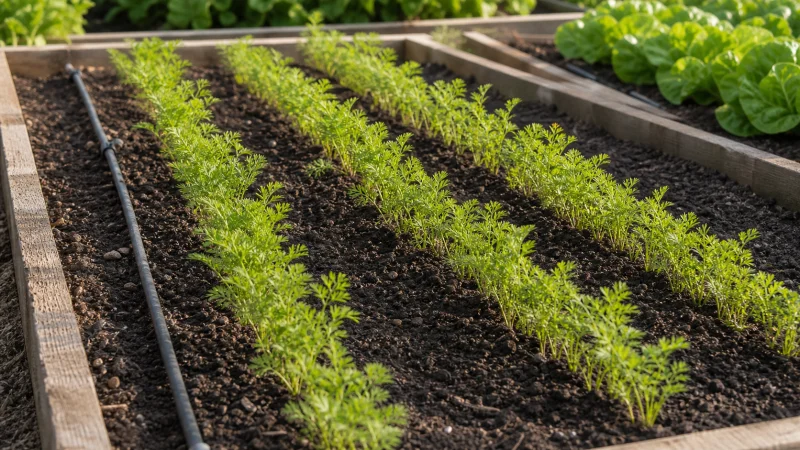
The root needs a clear path before the seed goes in
A carrot root does not wait until it is thick to begin responding to the soil around it. If the young root meets clods, stones, hard layers, or old coarse roots, it may bend or fork long before the foliage gives any warning.
The goal is not deep, aggressive digging everywhere. It is a fine, even layer through the zone the carrot will actually use. In a small garden, that may mean raking the surface several times, breaking clods by hand, and removing obvious debris. In heavier soil, a slightly raised bed is often more forgiving than a low bed that crusts after rain.
Small seed needs shallow sowing and patient moisture
Carrot seed is small and slow to show. When it is buried too deeply, emergence becomes uneven and the row can look patchy for weeks. A shallow sowing into a prepared surface, followed by a thin cover of fine soil, usually gives the seedlings a better start.
Moisture before emergence should be gentle. Heavy watering can move seed out of the row, while a dry crust can stop weak seedlings at the surface. Light watering, short-term surface protection, or a fine mulch layer can help, but the covering has to come off once seedlings need full light.
Late thinning shows up as crooked roots
Because carrot seedlings look delicate, it is easy to delay thinning. The problem is that the roots are already occupying space underground while the tops still look harmless. Crowded seedlings may keep growing, but the main roots can begin to press, curve, or compete.
Thinning can be done in stages. First remove weak seedlings and obvious clusters, then make a second pass when the target root size is clearer. If the stand is already uneven early, differences in root size, length, and shape usually become more obvious by harvest.
Moisture swings make splitting more likely
Carrots need steady water, not occasional rescue watering. A dry bed followed by a sudden heavy soak can push roots to expand quickly, and the outer tissue may not keep up. Long wet periods are not ideal either, especially if the lower layer is tight and roots stay shallow.
A better habit is to keep the bed consistently moderate and to check soil, not just the calendar. Drip lines and slow watering can both work if they match the bed. This is where carrots differ from potato hilling and trial digs: potatoes are managed around a bulking layer, while carrots are much more sensitive to the early path of one main root.
Good tops do not prove good roots
Healthy foliage is useful, but it is not a full quality report. A carrot can carry strong leaves while the root is becoming oversized, woody, forked, or split. Dense stands and delayed harvest often make that gap more obvious.
The same kind of above-ground mistake appears with sweet potatoes, where heavy vines can hide weak root development. Carrots are a different crop, but the lesson is the same: do not let visible growth replace a real harvest check.
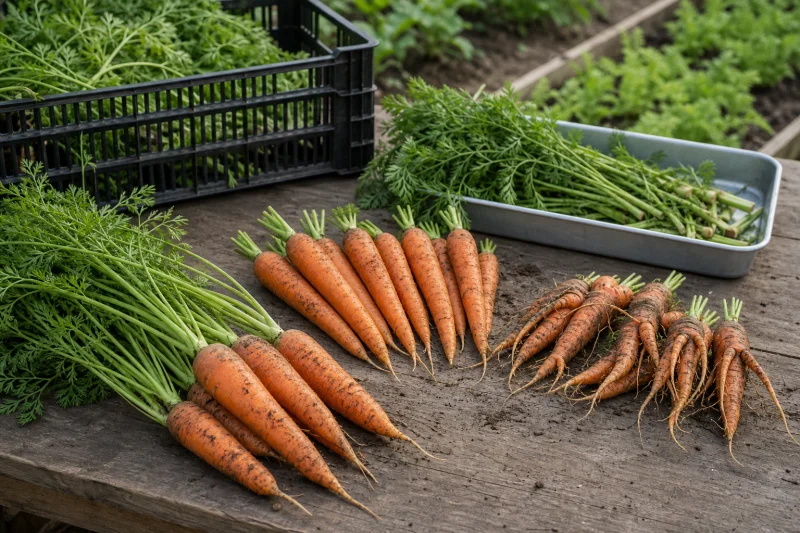
Pull a few before the whole bed is ready
As the crop approaches harvest, pull several carrots from different parts of the bed. Check root diameter, length, surface quality, and the share of forked or split roots. If enough roots are already at the size you want, waiting for every plant to catch up can reduce the quality of the best ones.
After harvest, sort the crop simply: straight roots, short roots, forked roots, and split roots. That sorting is useful feedback. Many forked roots point back to clods, hard spots, or old roots in the seedbed. Many split roots suggest moisture swings. Wide size differences usually come from uneven sowing, slow emergence, or thinning that came too late.
Do not blame the variety first. Variety matters, but seedbed texture, spacing, watering rhythm, and harvest timing create the base quality. The roots you pull this season are the clearest notes for the next seedbed you prepare.