Getting carrots to emerge evenly is only the first step. Many forked, narrow, or uneven roots begin as a spacing problem long before harvest. When seedlings stay crowded, or when the row surface becomes crusted and uneven, later watering cannot fully correct the early root direction.
If the previous stage is about keeping a summer carrot seedbed from drying out, the next stage is thinning. Once the stand is visible, the grower has to decide which seedlings are worth keeping before the tops hide the row.
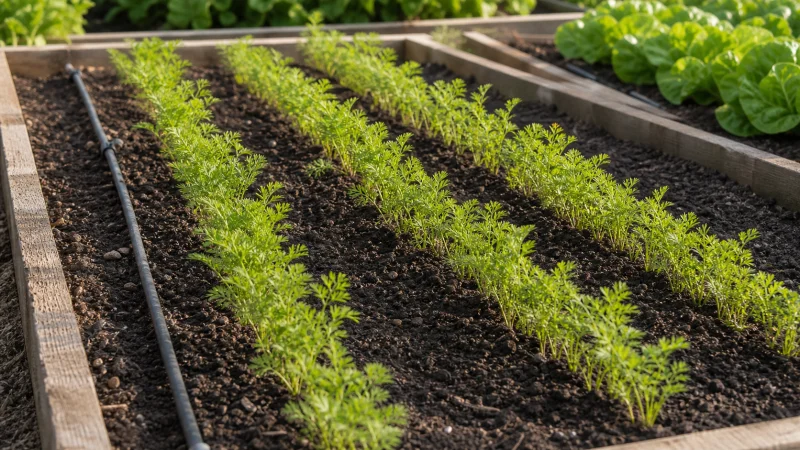
Start reading spacing when true leaves appear
Young carrot seedlings look delicate, so it is tempting to leave extra plants as insurance. After true leaves expand, however, seedlings that touch each other are already competing below the surface. Waiting too long does not always produce stronger plants. It can leave the final plants with a less stable root direction.
The first thinning pass can be gentle. Remove seedlings that are obviously crowded, weak, leaning, or outside the row line. A second pass can set the final spacing once plant strength is easier to judge. Thinning is less about making the row look sparse and more about lowering root competition before bulking begins.
The tallest seedling is not always the best one
A tall carrot seedling may simply be stretched by shade or crowding. A better choice has normal color, a steady base, a straight position in the row, and enough space around it. These details matter more than height alone.
Look at the row as a whole, too. A dense patch next to an empty patch makes later watering and harvest checks harder to read. Even spacing helps light, moisture, and root room move in a more predictable rhythm.
Keep the surface open after thinning
After thinning, the seedbed surface can still create problems. Heavy watering followed by fast drying may leave a crust that slows young roots and reduces air movement near the top layer. The goal is a fine, open surface, not deep disturbance that damages small roots.
Carrot shape is closely tied to the condition of the seedbed, as the broader carrot root-shape guide explains. Post-emergence care should protect that prepared layer so it does not turn into a hard, uneven surface.
Late seedlings are not always worth saving
Small gaps in the row can be frustrating, but filling every gap does not always improve the crop. Late seedlings often stay behind the rest of the row. If the whole bed is managed around those late plants, the stronger and more even section can lose its rhythm.
When gaps are minor, it is often better to keep the remaining stand uniform. When gaps are large, adjust the next sowing or another bed instead of keeping too many seedling ages in one row.
Early spacing makes later harvest checks easier
Near harvest, growers often judge carrots by shoulder size, top strength, and sample pulling. Those checks are more useful when the stand began with similar age and spacing. If one bed contains too much variation, a few pulled roots may not represent the row well.
That is why thinning is part of harvest quality, not just seedling cleanup. When the time comes to read carrot shoulders before harvest, the value of an even early row becomes much easier to see.