Lotus root grows below a field that can look calm from a distance. From the bank, the water may appear even, the leaves may look green, and the bed may seem to need no attention. A closer look often tells a more useful story: one edge holds water differently, a section of leaves sits at another height, or the visible channel has become hard to read after ordinary weather and field work.
The point of a bank-side check is not to chase one permanent water level. Lotus root beds change with growth stage, soil, weather, and the way water moves through a particular field. What matters first is whether the surface still gives you a clear picture of what is happening above and below it.
Look along the water before stepping into the bed
Start from the edge and follow the visible water line toward the far end. Is the surface continuous, or does one corner look noticeably different? Can you still see where the water meets the plants and the bank? Does the leaf pattern change sharply from one area to the next? These are observations, not a cue to make an immediate blanket correction.
For a crop that develops underground, the bank is an important viewing point. Entering the bed too quickly can make it harder to see the original pattern and can disturb the area you are trying to understand. A slow look from the edge gives context before any necessary work begins.
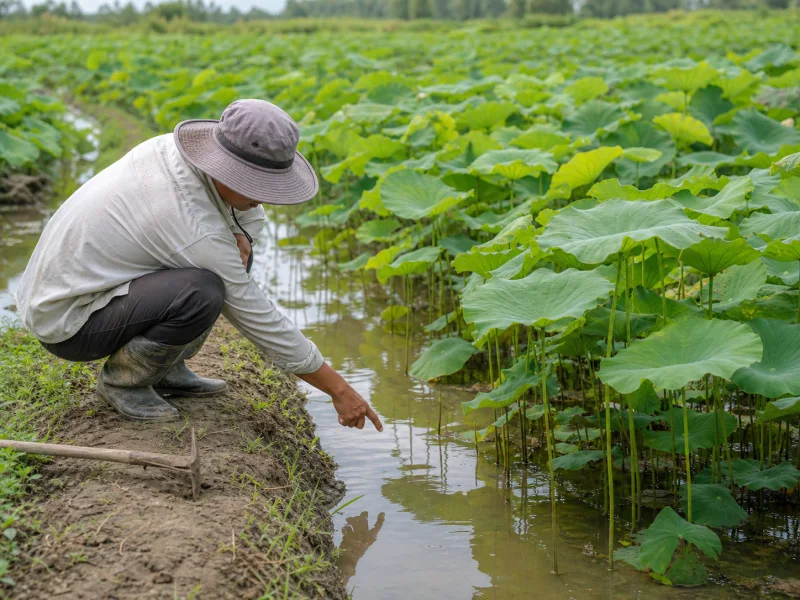
Use the leaves as a map, not a wall
Lotus leaves naturally create a dense layer as the bed develops. Rather than treating every variation as a problem, compare several places: the field edge, the middle, and an area that receives water differently. Are upright leaves appearing in a broadly similar pattern? Is one section consistently ahead or behind? Can the water channel still be read between plant groups?
The answer will not always be a change in water. Sometimes the observation is simply a reason to return and compare the same place again. That restraint matters because the visible surface is part of the evidence, and fast changes can make the next observation less clear.
Keep field edges useful for the next check
A lotus root bed is easier to manage when the bank, inlet or outlet area, and accessible edge still provide a consistent point of view. Avoid allowing routine work to erase every reference point. A narrow visible run of water or a recognizable leaf pattern can help you see whether the next visit is showing the same condition or a new one.
- View the water surface from more than one point on the bank.
- Compare leaf height and spacing across several parts of the bed.
- Notice a pattern before deciding it needs a response.
- Keep the next observation possible without unnecessary disturbance.
Let the water surface keep the conversation open
The useful outcome is a field you can read on the next walk. When the water surface, the leaf layer, and the field edge remain understandable together, the grower has a better basis for deciding whether conditions are stable or genuinely changing.
For lotus root, that is a practical form of care. It respects that much of the crop is out of sight while making the visible part of the field work harder for you.