A few leaves for dinner are a small request, yet a pot of cilantro can still miss the moment. One week it is too young to pick much; later, when you finally want a generous handful, a flowering stalk is rising through the middle. Filling a bigger pot with seed on the same day does not solve that timing problem. It mostly gives you more plants of the same age.
A small rotation is easier to manage: one pot for picking, another coming along, and, if space allows, a third freshly sown. The pots will not always hand over neatly. Cool weather can stretch a leafy harvest, while heat can shorten it sharply. What the arrangement gives you is another batch to work with, rather than a promise that one plant will keep producing indefinitely.
Give each cilantro sowing its own pot
Use containers with drainage holes and enough depth for root growth, filled with a free-draining potting mix. A shallow decorative dish makes the planting look complete before it provides much rooting space. Sow into the pot you intend to grow, following the seed packet's depth and spacing guidance. Utah State University's cilantro guide notes both the need for a deep enough container and the importance of minimizing root disturbance when transplanting.
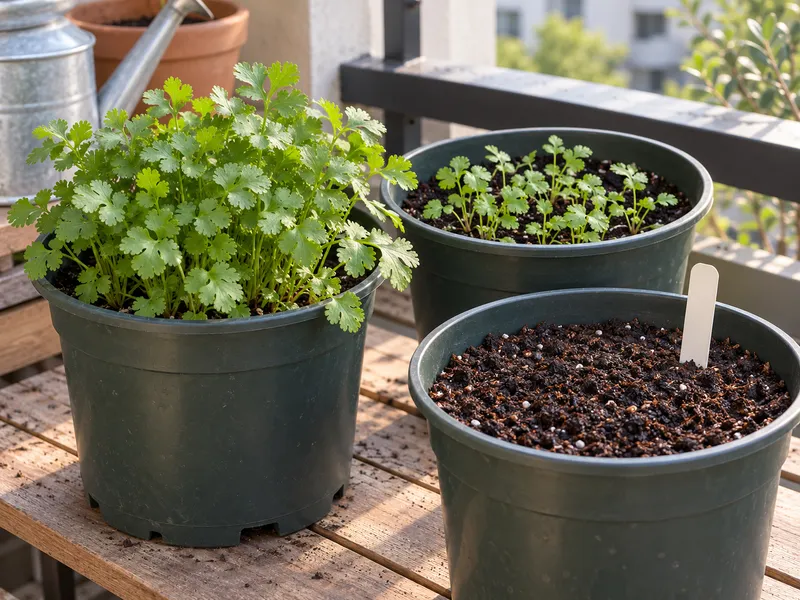
Keep the seed zone moist during establishment without leaving the container standing in water. Check the mix itself, not just the color of the surface. A fine rose or gentle stream is easier to control than a heavy splash that shifts seed around. The seed-zone moisture checks used for summer carrot sowing also help explain why one missed dry spell can matter before a leafy crop has even emerged.
Write the variety and sowing date on a marker. Choose a culinary leaf variety, preferably described as slow to bolt, if leaves are the goal. That wording buys an opportunity, not immunity from flowering. Do not crowd the pot to hide slow emergence, and do not keep adding seed to unexplained gaps every few days: soon you will have several ages mixed together with no clear starting date.
Start the next batch while the first still looks useful
The practical mistake is waiting until the picking pot is finished before sowing again. Seeds and seedlings need time, so that leaves a gap even in favorable weather. University of Maryland Extension suggests successive sowings every two to three weeks. Treat that as a starting experiment in a suitable cool growing window, then adjust it to what your own pots actually do.
For the first round, keep the arrangement simple:
- Sow one modest batch and record when seedlings appear.
- Sow the next pot before the first becomes your only reliable source of leaves.
- Compare how long each batch takes to reach useful picking size and how long it stays leafy.
If the younger pot is still tiny when the older one begins flowering, your next sowing may need to come earlier, or your planting window may be ending. If two pots become ready together and much goes unused, reduce the size of each batch. This is a kitchen-supply decision: the useful measure is how much cilantro you pick, not how completely the bench is covered in green.
Plan around the local cool season rather than importing someone else's calendar months. As with lettuce grown in small repeated plantings, the planting window and harvest style belong together. A schedule that works on a mild balcony may be unworkable on a hot terrace or during a dark, cold spell. When growth stalls or plants rush to flower, adding more identical pots is not necessarily the answer.
A taller cilantro plant may be changing jobs
Look into the center of the oldest pot. An extending stem, increasingly fine upper leaves and, eventually, small pale flower clusters indicate a move toward flowering. Do not compare those lacy leaves only with the broad ones in the younger pot and assume the variety has changed. The University of New Hampshire's herb handbook describes the contrast between broader leaves and more delicate, divided foliage on the flowering plant.
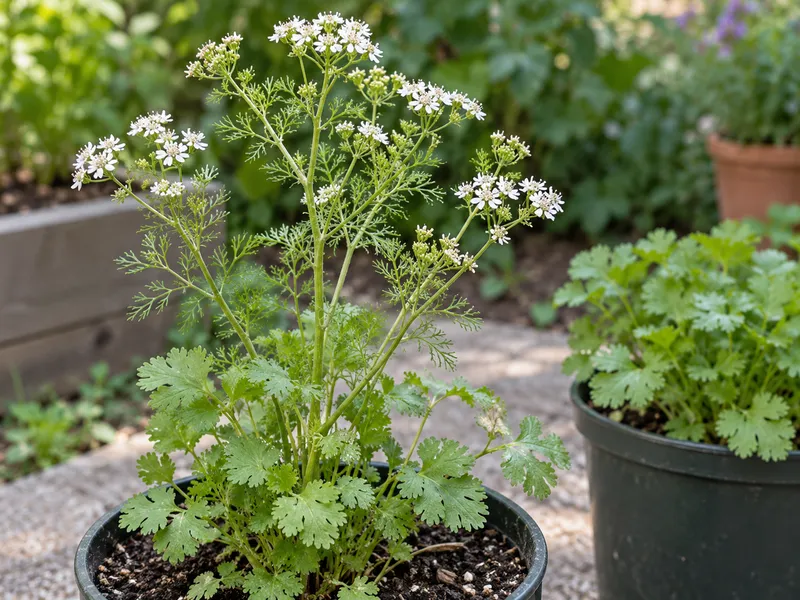
Both temperature and day length influence this transition, according to Oregon State University Extension. Moving a pot out of harsh afternoon heat may help extend its useful period, but a brighter indoor windowsill or a shaded corner is not a guaranteed reset. Keep adequate light while avoiding an overheated position; deep shade that produces weak growth is a different problem.
Pinching off an early flower stalk can extend leaf picking for a while, as Maryland's guidance notes. Use that time to take usable leaves, rather than expect a fully flowering plant to become a young leafy clump again. If you keep a pot for flowers or coriander seed, give it that role deliberately and leave space for the younger leaf crop. You do not have to turn every aging pot into a rescue project.
Pick lightly, then let the next pot take over
Begin with small pickings from well-established plants instead of stripping young seedlings as soon as a garnish is possible. Illinois Extension describes harvesting individual leaves or whole plants, depending on the intended use. In a pot you want to revisit, leave enough healthy growth for the next check. If you choose a whole-bunch harvest, count that batch as finished and plan the replacement accordingly.
Notice what comes back after picking. The new growth, not a pot's old reputation, tells you whether another modest harvest is realistic. Leave a weak or recently stressed batch alone while it recovers. Wilted leaves call for a moisture and root-zone check before fertilizer; more feed does not explain why a pot is staying wet or drying unusually fast.
When an old planting is no longer useful for leaves, remove it and clean the container before preparing the next batch. Do not sow into a dense mat of old roots simply to preserve the calendar. If a pot has unexplained collapse or disease symptoms, investigate those before reusing its mix. Keep the date marker with the next sowing, and judge the rotation by the next fresh handful—not by how long you can keep the first pot alive.