Chinese cabbage can look strong during the leafy stage and still become uneven when the heads begin to tighten. Large outer leaves are useful, but they are only the frame. The real test is whether the plant can keep water, root activity, and leaf wrapping steady while the head forms.
This article is narrower than the Chinese cabbage growing guide, which covers sowing date, spacing, drainage, and early moisture. It focuses on the heading stage: when to keep water steady, how to read the wrapper leaves, and how to avoid pushing the crop into loose, cracked, or stressed heads.
Heading starts before the head looks full
The heading stage begins when the inner leaves start folding and overlapping, not when the head already feels heavy. If management waits until the head is tight, there is little time left to correct uneven water or weak root conditions.
Walk the field before the heads are fully closed. Compare plants in wetter strips, drier strips, row ends, and areas with weaker stand. A field can look uniform from the edge while the inner leaves are already forming at different speeds.
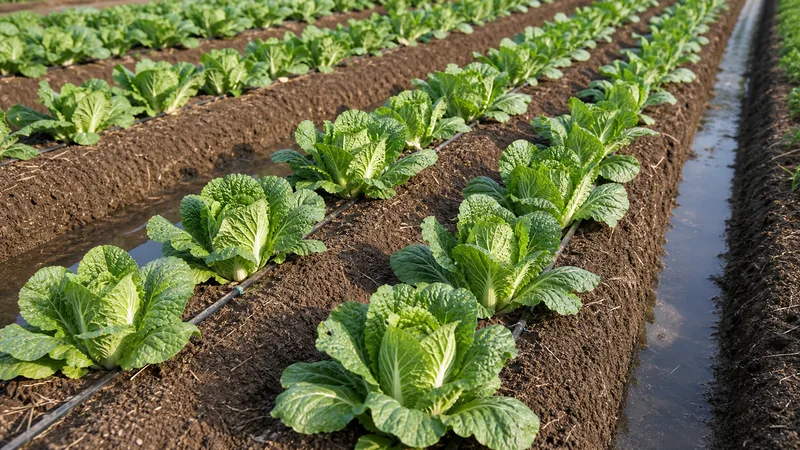
Water should be steady, not dramatic
Chinese cabbage needs enough moisture during heading because the leaves are expanding and wrapping quickly. The problem is not only drought. A dry spell followed by heavy watering can make heads grow unevenly, split more easily, or form with weaker outer support.
A better rhythm is to keep the root zone consistently moist without leaving the bed wet and airless. After rain or irrigation, check whether water is moving away from the row or sitting around the base of the plants. A saturated bed can stress roots even when the crop looks well supplied from above.
If the crop is being grown through warm weather, the summer lettuce cooling guide is a useful comparison: leafy crops can lose quality quickly when heat and water swings arrive together.
Wrapper leaves protect the head
The outer leaves should not be treated as useless cover. They shade the forming head, buffer wind and sun, and help the plant keep a stable shape. Damaged, yellowing, or badly wilted wrapper leaves often warn that water, spacing, or root activity has not stayed even.
Do not remove healthy wrapper leaves just to make the head look cleaner in the field. Cleaning belongs closer to harvest and packing. During heading, the plant still needs those leaves to feed and protect the head.
Feeding should support wrapping, not force bulk
Late feeding should match the crop condition. If the stand is already uneven, pushing growth too hard can enlarge the difference between stronger and weaker plants. If the soil is dry, feeding without correcting moisture will not solve the main problem.
Use the plant as the guide: leaf color, head firmness, root-zone moisture, and the speed of wrapping should be read together. Strong heading comes from a balanced plant, not from one late push after the head has already started to close.
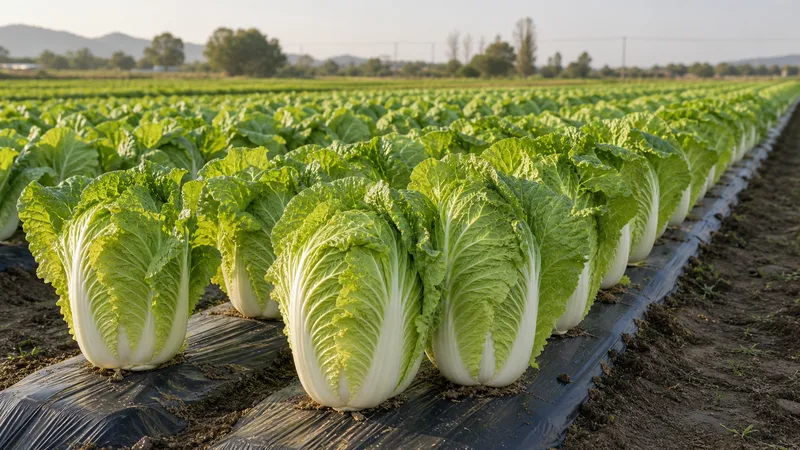
Good heading makes harvest handling easier
A head that forms evenly is easier to cut, cool, sort, and pack later. Loose heads, split heads, and plants with weak wrapper leaves create more trimming and more loss after harvest.
That connection is why heading-stage notes should be kept for the harvest crew. If one area had water stress, late wrapping, or weak outer leaves, it should be checked earlier at harvest. The Chinese cabbage harvest and cooling guide picks up from that point, when field heat and sorting begin to matter more than growth.
For this crop, the best heading management is quiet and consistent. Keep the bed draining, keep moisture even, protect the wrapper leaves, and adjust feeding to the plant that is actually in the field.