Peas can give a garden two very different harvests. A close, quick crop of tender shoots uses the bed as a cutting patch. A pod crop uses the same seed as the start of a longer arrangement of stems, flowers, support, and picking space. The mistake is not choosing one over the other. It is sowing without deciding which job the row is supposed to do.
That choice does not need to be permanent for the whole garden. It only needs to be clear for each strip of soil or container. Once a bed fills in, it becomes much harder to turn a dense shoot patch into an accessible pod row, or to cut a trellised crop repeatedly without interrupting the plants you meant to carry onward.
The harvest decides the shape of the bed
For shoots, the useful picture is a close, even patch where many young stems can be cut lightly at once. There is no reason to reserve long lanes between individual plants when the goal is a compact, leafy harvest. The bed should be easy to reach from one side, and the plants should be treated as a short-lived cutting crop rather than as vines waiting for a tall structure.
For pods, leave enough room to see each plant develop and to reach the vine later. The difference is not just space around the seedling. It is space for a support, a hand moving along the row, and pods that can be found before they become too mature. Planning this early avoids the late-season compromise of trying to pull a crowded mass of vines apart.
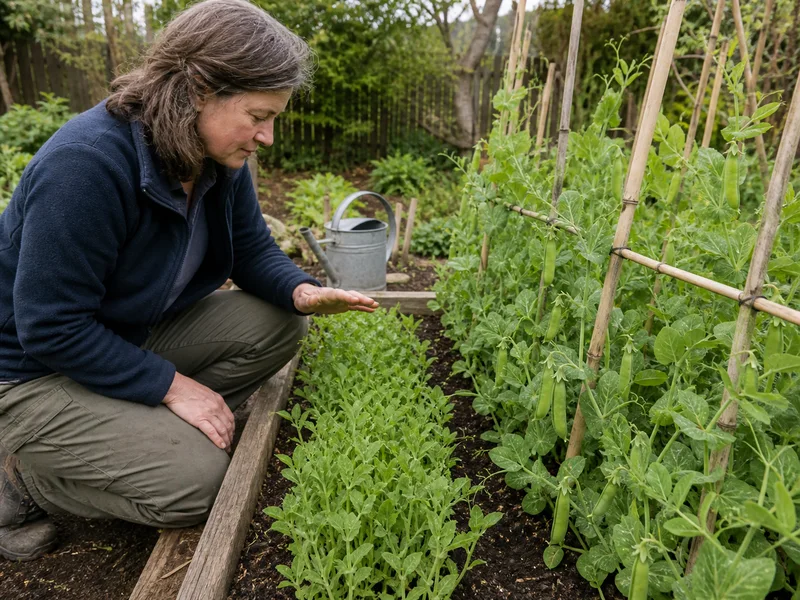
A dense strip works when cutting is the plan
With pea shoots, gentle repeated cuts can make sense because the harvest is the purpose of the planting. Keep the cutting light enough that some living stem remains, then let the next flush tell you whether the patch still has energy for another pass. A patch that becomes uneven, tired, or difficult to water evenly is not a failure; it is a signal that the next sowing can take over instead of asking the same plants to do too much.
Think of this as succession in miniature. A small fresh strip often gives a clearer result than one crowded patch kept indefinitely. The same early decision matters in root crops: this carrot thinning guide shows why the usable shape of a row is easiest to protect before leaves hide the ground and the roots begin competing for unseen space.
A pod row needs a future path
Once a pea planting is meant to carry pods, avoid treating every new tip as something to cut. Let the vines claim their support and keep the edge of the row open enough to look beneath the leaves. The support does not have to be elaborate, but it should be in place before the plants lean across one another and make it difficult to tell which stem belongs where.
The useful test is simple: can you follow a vine with your eyes, find the hanging pods, and reach them without pulling leaves aside by force? That is the same harvest-access question explored in this yardlong bean pod visibility guide, even though peas are a much lighter crop. A plant can look vigorous and still be awkward to pick when its fruiting space has disappeared.
Two small rows can be better than one confused row
A compact garden does not have to choose between shoots and pods forever. One short dense strip can be dedicated to cutting, while a nearby open row is allowed to climb and fruit. Keeping the two roles separate makes watering, support, and harvest decisions easier to understand. It also gives the gardener an honest comparison of what each use asks from the same seed.
Before sowing, label the decision in your own notes: cut or climb. That private reminder is enough. The point is not to make a bed look perfectly organized. It is to make sure the first harvest does not undo the harvest you hoped to have later.