The weeks after pomegranate fruit set can tempt a grower to do too much. A tree that has finished a strong bloom may look busy everywhere at once: young fruit, fresh shoots, dense leaves, and late flowers can all share the same branch. The useful work is not to make every tree look equally tidy. It is to decide which parts of the orchard are carrying a clear, workable crop and which parts need to be watched again before they are changed.
That makes this a good time for a slower orchard walk. Instead of beginning with a list of jobs, begin with three observations: where the fruit is sitting, whether light can still reach into the canopy, and whether the ground is drying or staying wet at the same pace across the block. Those observations make later choices more proportionate.
Read clusters before you decide what to remove
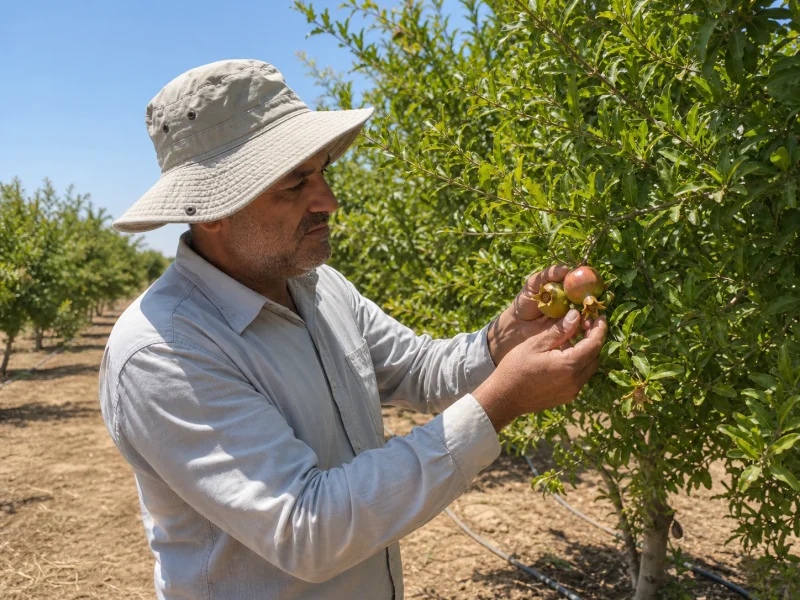
Start with a few representative trees, including one near an edge, one in the middle, and one where the soil or water movement feels different. Look at the young fruit in its actual position. A pair held tightly together, a small fruit hidden behind dense new growth, and an open, well-spaced fruiting shoot do not present the same future work.
The first question is not how many fruit a tree has in total. It is whether the tree is carrying obvious competition at the same points. Where fruit is crowded, poorly formed, or clearly late beside a stronger set, make a note of the pattern. Where it is already spaced and the leaves are feeding it without closing the view, the better decision may be to leave it alone for now.
That distinction prevents a common mistake: treating every visible flower or every small fruit as a problem to solve. Pomegranates often show more than one stage at once. The orchard becomes easier to manage when the earliest, strongest set is separated in your mind from the later activity that may never develop on the same schedule.
Open access to the fruit, not an empty canopy
Fresh shoots can quickly hide the lower and inner fruiting positions. A little selective work can restore access, but a hard summer cut can take away useful leaf area and make the tree harder to read. Stand back before cutting. If you can see into the center at several angles, follow a fruiting branch without forcing it aside, and walk under the tree without fighting low growth, the canopy may already be doing its job.
When a branch is clearly crossing the working space, a dense shoot is growing straight through the center, or basal growth is competing with the chosen structure, deal with that specific obstruction. Do not turn a few local problems into a complete reshaping of the tree. Young trees, vigorous trees, and established fruiting trees do not all need the same degree of intervention.
A useful result is modest: the fruit remains shaded by healthy foliage, the working path is visible, and the next walk can still show you what has changed. The goal is not a geometric outline. It is a canopy that lets you assess fruit and moisture without guessing.
Let the ground set the pace for the next visit
Early-summer pomegranate work is tied closely to water movement, especially where one part of an orchard dries sooner or holds rain longer than another. Check the surface near a few trees after the same irrigation or weather event. Look for a zone that is consistently slower to dry, a zone where the soil opens quickly, and a normal area between them. The contrast is often more useful than one reading taken beside the pump or at the gate.
Use those differences to schedule the next visit, not to force an immediate block-wide response. Return after the next meaningful change in weather or irrigation and compare the same trees: are the selected fruit holding their pace, has the canopy become harder to see through, and are the ground conditions still separating the orchard into the same zones?
A pomegranate orchard in early summer does not need to be pushed toward a single picture. It needs enough light, space, and observation for the strongest fruiting positions to remain clear. A lighter hand now leaves more information for the next decision.