After pear bloom, a tree full of young fruit can look reassuring. That is exactly when the next problem begins. Too many fruitlets, poor fruit position, upright shoots, and shaded canopy areas can all compete before the grower notices that the tree has become too crowded to manage easily.
For orchard spacing, support, and basic tree structure, start with the main pear growing guide. This article is narrower: it follows the period from bloom through summer, when fruit load, shoot growth, and light need to be adjusted before the canopy closes.
Heavy bloom does not mean every fruit should stay
When pear bloom is strong, the first risk may not be a lack of crop. It may be carrying too much. Fruit clusters, fruit position, and branch strength should be judged together. A weak branch carrying too many fruitlets can lose vigor, while shaded interior fruit may remain uneven even if it stays on the tree.
Earlier thinning saves more tree energy than late correction. Once fruit set is clear, remove crowded, poorly placed, misshapen, or weakly supported fruit first, then adjust the final load to match tree vigor. The same principle appears in apple fruiting wood and crop-load planning: more fruit is not always better if the branch system cannot support it.
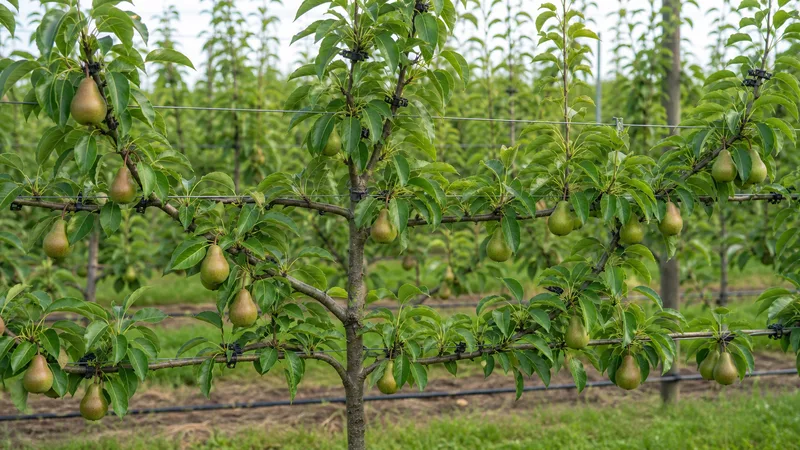
Choose fruit position before chasing fruit size
Pear size and uniformity later in the season are strongly affected by early fruit position. Fruit with better light, stable branch angle, and less rubbing pressure is more likely to finish evenly. When several fruit are crowded along the same small section of branch, later watering and feeding cannot fully solve the spacing problem.
Thinning should not look only at the biggest fruitlet. It should also ask where that fruit is growing. Deep shade, weak wood, rubbing points, and fruit tucked into a congested part of the canopy deserve early attention. This makes summer pruning, harvest, and grading easier later.
Summer pruning should open access, not strip the tree
Summer shoots compete with young fruit, especially upright shoots near the top of the canopy and shoots close to fruiting positions. If they are ignored, the canopy thickens quickly and light drops. If too much is removed at once, the tree loses useful leaf area and fruit sizing can suffer.
Summer pruning is better treated as access and light management. Remove shoots that clearly have no space, point in the wrong direction, or shade important fruiting zones. Keep useful leaves and renewal wood so the tree can still feed the crop. This is close to the logic in citrus pruning for light and airflow: the goal is not to empty the canopy, but to make it work.
Before bagging or fruit protection, clean up the crop load
Some pear orchards use fruit bags or other early fruit protection. Whatever the system, the fruit position should be sorted first. If crowded or poorly placed fruit are protected too early, the orchard may simply preserve uneven fruit instead of improving quality.
Before protection work, look beyond the fruit surface. Branch angle, fruit hanging direction, nearby shading leaves, and access along the row all affect later management. If the canopy is already too dense, harvest, grading, and storage decisions become harder.
During fruit sizing, avoid spending next year’s tree strength
Pears are perennial trees, so this year’s crop cannot be managed as if the tree ends at harvest. A heavy fruit load during sizing can pull energy away from renewal wood, flower bud formation, and postharvest recovery. The risk is higher when tree vigor is moderate, soil moisture is uneven, or the canopy is already shaded.
It helps to compare pears with peach renewal wood and postharvest recovery. The pruning systems differ, but both crops need enough useful leaf area and renewal growth to avoid letting one season weaken the next.
Three field questions are enough for each pass
From bloom through summer, a pear orchard pass can stay focused by asking three questions. Are fruit concentrated on too few branch sections? Are vigorous shoots shading the main fruiting zones? Does light still reach the inside of the canopy?
The goal is to give fruit, leaves, and branches each a clear job. Thinning keeps the load realistic, summer pruning lets light in, and harvest grading becomes less of a rescue step. Doing this work early makes the rest of the season easier to manage.