A jicama planting can look settled from the path long before the underground crop has offered a clear answer. The vines cover their supports, the bed turns green, and it is tempting to let that scene stand in for the whole plant. But jicama has two stories running at once: the work happening above the soil and the root taking shape below it.
This is not a guide to forcing either one. It is a field note for the moment when a gardener wants to look more carefully without turning every visit into a harvest decision. Separate the signals first; then decide whether the bed needs time, a closer look, or simply another ordinary pass through the garden.
Read the vines for what they can actually tell you
A full canopy tells you that the above-ground part of the crop has found room to climb and make leaves. It does not automatically describe the size, shape, or readiness of a root below the surface. Treating a green wall of vines as a complete progress report creates a false certainty, especially when the crop is being viewed from only one edge of the bed.
Walk along the row instead of judging it from a single good-looking spot. Notice whether the supports, pathways, and lower stems still leave the bed understandable. The purpose is not to give the vines a score. It is to avoid letting one highly visible part of the crop answer a question that belongs underground.
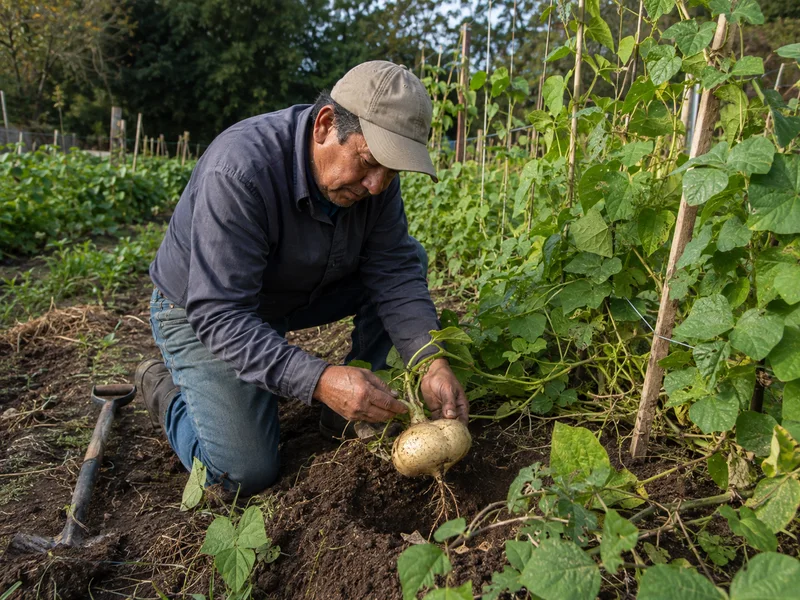
Let one careful check remain just one check
When the moment calls for closer observation, choose it deliberately and keep the reason in view. A lifted or exposed root is useful as a sample, not as an excuse to disturb every plant until the bed produces a reassuring picture. Return the rest of the row to ordinary observation and keep the small finding in proportion.
That distinction is familiar in other root crops. In the carrot shoulder and harvest sorting note, the visible top is treated as a cue to look closer rather than a promise about every root in the bed. Jicama asks for the same restraint, even though its vine growth makes the surface scene look very different.
Make the next visit easier than this one
After a closer look, leave a short, practical note: which part of the row was checked, what the vines looked like there, and what the root observation did or did not settle. This is more useful than trying to turn one visit into a universal rule. On the next pass, it gives you a real comparison instead of a memory shaped by the most impressive patch of foliage.
The note can also protect the garden from a common mistake: treating vigorous leaves as a reason to make every crop decision faster. The sweet potato bulking and vine guide makes a related point from another sprawling root crop. Plant growth is a conversation between visible foliage, soil, and the eventual root; it is not a single signal with one fixed meaning.
What this field note leaves open
Jicama is worth returning to because the first observation should not close the subject. A later note can focus on how a home bed is laid out for access, how a gardener decides which part of a row to sample, or how the crop is handled after a root is chosen for use. For now, the useful habit is simpler: let the vines be vines, let the root be a root, and give each one the kind of attention it can support.