A grafted eggplant seedling carries two plants in one pot. The upper stem is the fruiting variety you chose; the lower stem and roots belong to the rootstock. Between them is a short, easily overlooked union that determines how the plant should be handled. If that line disappears below the garden soil, or a shoot from the rootstock is allowed to take over, much of the reason for buying a grafted plant can be lost.
This is why the useful inspection starts before the planting hole is dug. Set the pot on a bench, turn it slowly, and read the seedling from the newest leaves down to the potting mix. You do not need to judge it by height alone, and you should not pull at the graft to prove that it is strong.
Find four landmarks on the plant
1. The scion. Above the union, the eggplant top should be actively growing without severe wilting, broken leaves or a damaged growing point. A small seedling can be entirely suitable if the stem is steady and the growth is balanced. A very tall top on a weak, leaning stem is not automatically a better transplant.
2. The graft union. Look for a change in stem color or thickness and, on a recently grafted plant, a clip. The two stem sections should meet without a visibly open gap, dark collapse or movement when the pot is handled normally. A healed union may remain slightly swollen or angled; cosmetic smoothness is not the goal. Penn State's overview of vegetable grafting explains that the rootstock and scion must reconnect their vascular tissues during healing.
3. Everything below the union. A leaf or new side shoot arising from the rootstock is not part of the selected eggplant variety. Purdue Extension's vegetable-grafting guide advises scouting for and removing rootstock suckers before transplanting. Identify the origin first: removing an eggplant leaf above the union by mistake only reduces the working leaf area.
4. The root ball. Water the plant if the mix is dry, then ease the pot away while supporting the plug. Look for a root ball that holds together without being a solid circling mass. Sour odor, blackened roots, saturated mix that has stayed airless, or a plug that collapses because it has almost no roots deserves investigation before planting. This complements the site's general eggplant transplant guide; the extra task here is preserving the grafted plant's two-part structure.
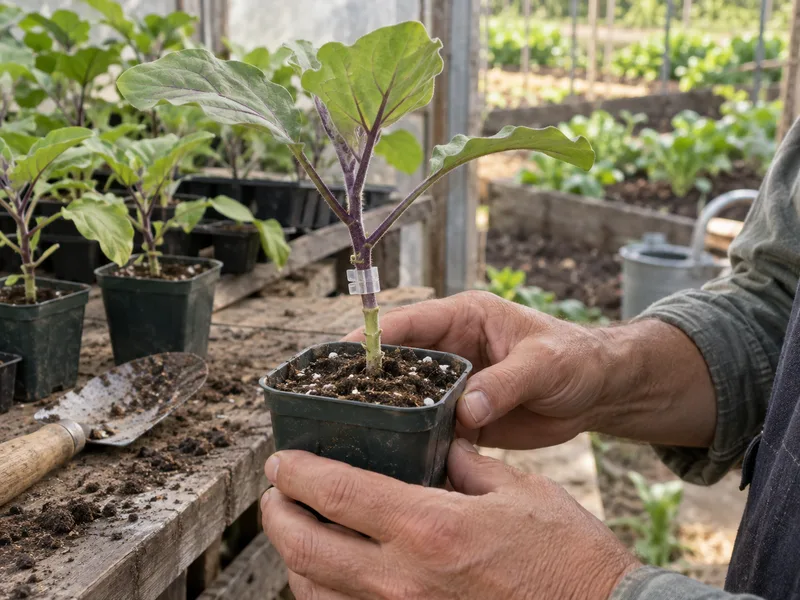
The planting depth is decided by the union
For an ordinary leggy tomato seedling, gardeners sometimes bury part of the stem. Do not transfer that habit blindly to a grafted eggplant. Position the root ball so the union remains clearly above the finished soil and anticipated mulch line. The purpose is to stop the scion from making its own roots into the soil, which would bypass the rootstock. Oregon State's guidance for grafted solanaceous vegetables likewise stresses keeping the union above soil and removing growth from below it.
Before backfilling, hold the plant at its intended height and check the view from two sides. Soil settles, mulch moves, and irrigation can wash loose soil toward the stem. Leave enough visible stem below the union that normal settling will not cover it. Firm the soil around the root ball rather than pressing directly on the graft, and water the root zone without blasting the stem.
If a support will be needed, place it without piercing the root ball and tie the plant above and below the union loosely enough to prevent rubbing. The graft clip is not a handle. Do not twist the plant by it, and do not force off a tight clip merely because transplant day has arrived. Clip designs and nursery instructions differ; remove or adjust it only when it no longer supports healing and can be handled without injuring the stem.
Recheck the identity of new growth
Return after the plant has settled and look at the same four landmarks. New wilting during midday can reflect transplant stress, but a top that remains collapsed while the root zone is wet needs a closer look at the union and roots. Do not answer every wilt with more water. Compare the moisture inside the root ball with the surrounding soil and check whether the stem was damaged during planting.
Watch especially for vigorous shoots below the union. Remove them while small, using clean hands or tools appropriate to their size, because they belong to the rootstock rather than the fruiting top. Also keep mulch and splashed soil from creeping over the union. Once flowering and fruit set begin, management shifts to canopy and crop load; the site's eggplant fruit-load article covers that later stage.
Grafting is not a universal shield against every disease, weather problem or management error. The rootstock must be compatible and selected for a relevant purpose, and the scion still needs suitable light, temperature, water and support. The crawled reference described one regional split-grafting program with fixed sowing intervals, temperatures and pesticide concentrations. Those details were not converted into universal instructions here. The transferable lesson is simpler: know which half of the plant you are looking at, protect the connection between them, and keep that connection above the soil.