Eggplant seedlings can look strong in the tray and still slow down after transplanting. Large leaves and thick stems help, but they do not tell the whole story. The better question is whether the root ball holds together, whether the seedling has stretched, and whether the plant can resume growth quickly once it is moved.
This guide pairs well with the broader eggplant growing guide, which focuses more on carrying the crop through repeated harvests. Here the focus is earlier: seedling condition, transplant timing, root-zone recovery, and the first few days after planting.
Do not judge seedling age by the calendar alone
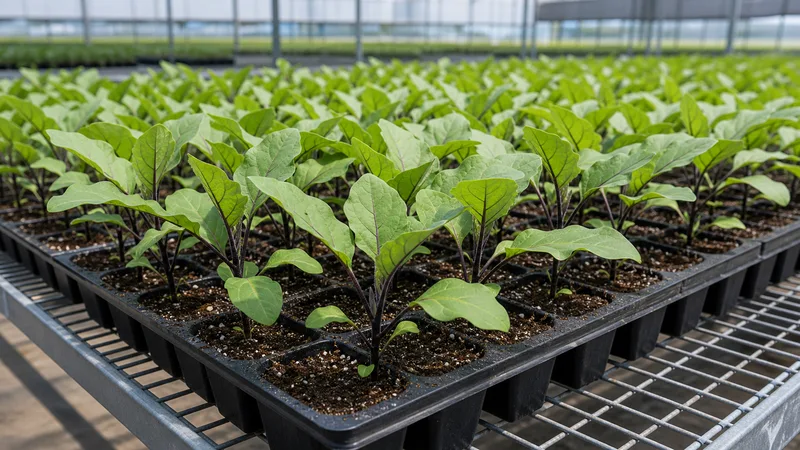
Eggplant likes warmth and often needs a longer seedling period than fast vine crops, but seedling age should not be counted only by days after sowing. Temperature, light, tray size, and growing medium all change how quickly a plant becomes ready. A transplantable seedling should have a root ball that holds together, leaves that are open but not crowded, and internodes that have not stretched too far.
If seedlings stay in the tray too long, roots can circle the cell and recovery becomes slower after planting. If they are moved too young, the root ball may fall apart and the transplant shock can be just as bad. The useful target is a plant that can be handled cleanly and then start growing again without a long pause.
Harden seedlings before the field changes everything
Seedlings raised under cover can meet brighter light, wind, and wider temperature swings as soon as they leave the nursery area. A few days of gradual ventilation and stronger light helps the plants shift from soft growth to a sturdier transplant stage. The goal is not to stress the plants until they wilt; it is to avoid a sudden jump in conditions.
The same idea shows up in pepper transplant recovery and watering. Solanaceous vegetables often struggle when seedlings are too soft or when growers push water and fertility before the roots are ready. Eggplant is no different: first recovery, then stronger growth.
Water the root ball, but do not leave it airless
Before transplanting, the root ball should be moist enough to stay together. The planting area also needs workable moisture. Trouble starts when “water well” becomes a soaked tray and a sticky planting hole. In that condition, roots have poor air contact and the seedling may recover more slowly.
A steadier approach is to adjust tray moisture before transplanting, plant firmly enough for soil-root contact, and then watch how the leaves recover. If the plant begins to stand up and new leaves stay active, watering can follow the field condition instead of a fixed daily habit.
Root recovery comes before early flowers
Right after transplanting, an eggplant seedling needs to rebuild water uptake, extend new roots, and settle into the bed. If the crop is pushed toward early flowering too soon, the plant may divide limited energy between roots, leaves, flowers, and young fruit. A few early flowers are not worth much if the plant loses momentum.
That balance is also useful when comparing eggplant with tomato watering swings and fruit quality. The crop problem is not identical, but unstable root-zone moisture often shows up later as uneven flowering, fruit set, or fruit shape.
Row spacing is decided while the plants are still small
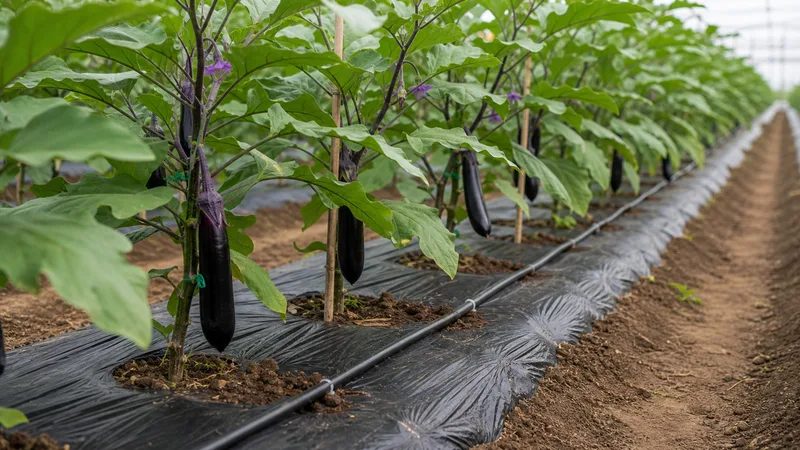
Eggplant looks manageable at transplanting, but mature plants carry large leaves and branching stems. If rows are tight from the start, later pruning, picking, and inspection become awkward. Many spacing problems are created before the crop looks crowded.
This is why early layout matters across different vegetables. The lettuce guide on timing, shade, and harvest windows is a very different crop, but it shares one lesson: early spacing and access decide whether later work stays simple or becomes a constant compromise.
A good seedling is one that keeps growing after it moves
The best eggplant transplant is not always the largest seedling in the tray. It is the plant with a firm root ball, balanced leaves, compact growth, and enough resilience to resume field growth quickly. A few days after planting, new leaf activity and less midday drooping are better signs than the original tray size.
If one seedling batch is uneven, weak plants can be kept for replacement instead of being mixed into the main planting. Eggplant is a long-bearing crop, and a more even start makes later watering, pruning, and harvest rhythm easier to manage.