Yardlong bean vines can look healthy from the top and still become difficult to work with at picking height. Leaves overlap, a flower hides behind a stem, and the tender pods that matter most disappear into the shaded lower part of the row. When that happens, the issue is not simply that the vine has become large. The crop has lost a useful working zone.
A productive bean row gives the picker enough information at a glance: where new flowers are appearing, where young pods are hanging, and where a hand can reach without pulling through a wall of leaves. This is a management view rather than a fixed pruning recipe. The aim is to keep the lower canopy readable as the vine continues to climb.
Start where the basket meets the row
Stand in the path you actually use for harvest and look along the lower third of several plants. Can you find hanging pods without lifting every leaf? Can you tell a newly set pod from a longer one that should be picked soon? Is there room for a basket without brushing every vine? These are small questions, but they reveal whether the structure of the row still serves daily work.
Do not judge the row only from its tallest growth. A vine can cover the support well and still put its most useful pods in a crowded, hard-to-see layer. When the lower part is open enough to inspect, the next picking becomes less about searching and more about choosing the pods at the right stage.
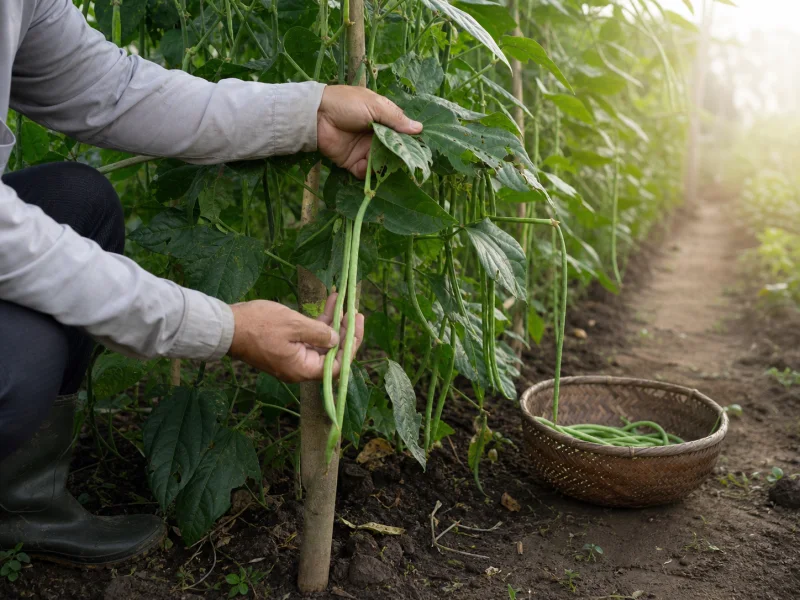
Let flowers, pods, and leaves occupy different visual layers
There is no need to make every vine look bare. Instead, notice when the lowest leaves are covering the same space where pods are meant to hang. A few well-placed adjustments during ordinary harvest can preserve a visible lower zone while leaving the upper vine to keep growing. The supports should guide the vine upward, not turn the row into a solid curtain from soil to tip.
One useful check is to look through the row from the end of the path. If every plant blends into one dense green surface, it is difficult to notice changes from one visit to the next. If the lower pods and a few stems remain visible, you can compare how the set is progressing without disturbing the plant just to find it.
Pick by pod stage, not by what is easiest to reach
It is natural to take the first pod a hand encounters. Over time, that habit can leave older pods hidden behind leaves while only the most exposed ones are picked. A short pause at each plant changes the routine: look for pods that have lengthened but still look smooth and supple, then scan once more behind the first leaf layer before moving on.
- Use the harvest path as the place to assess access, not only the far side of the row.
- Keep the lower pod zone visible enough to distinguish flowers, small pods, and ready pods.
- Handle the vine lightly; the goal is better visibility, not a stripped plant.
- Use each picking to notice where the next set is becoming hard to find.
Make the next walk easier than the last one
The best result of a bean harvest is not only the basket of pods. It is a row that is still straightforward to read tomorrow. When flowers, new pods, and mature pods do not all disappear into the same shaded layer, the grower can return with a clearer sense of what changed.
That is why a visible lower canopy matters. It turns a tall vine from a green wall into a sequence of small, practical observations, and it lets daily picking stay connected to the plant's next round of growth.