Red amaranth can make a bed look ready all at once. The leaves color up, the rows close together, and it is tempting to clear the patch in a single picking. For a home plot or a small market garden, that is not always the most useful choice. A bed with more than one stage of growth can be harvested in passes, leaving a clear next section rather than turning every plant into the same decision.
This approach is less about following a rigid interval and more about preserving a readable bed. One section becomes today's harvest, another stays as the next reference point, and the smaller plants are not asked to catch up overnight. It gives the grower something concrete to compare when returning to the row.
A harvest pass is also a spacing decision
Start by looking across the row before picking from it. Where have leaves begun to overlap so much that the stems and soil are difficult to see? Where are the plants still clearly separated, with room for the smallest leaves to develop? The crowded strip is often the natural place to start, because taking selected larger plants opens the bed without pretending that every leaf has reached the same stage.
Pick with the final use in mind. Tender leaves and young stems are usually the useful part of a red amaranth harvest, while a much taller plant may already be moving into a different texture. Instead of making the row look uniformly short, aim to leave a mix that still has light, air, and visible growing points. The remaining plants should look like a bed that can be observed again, not a row that needs immediate rescue.
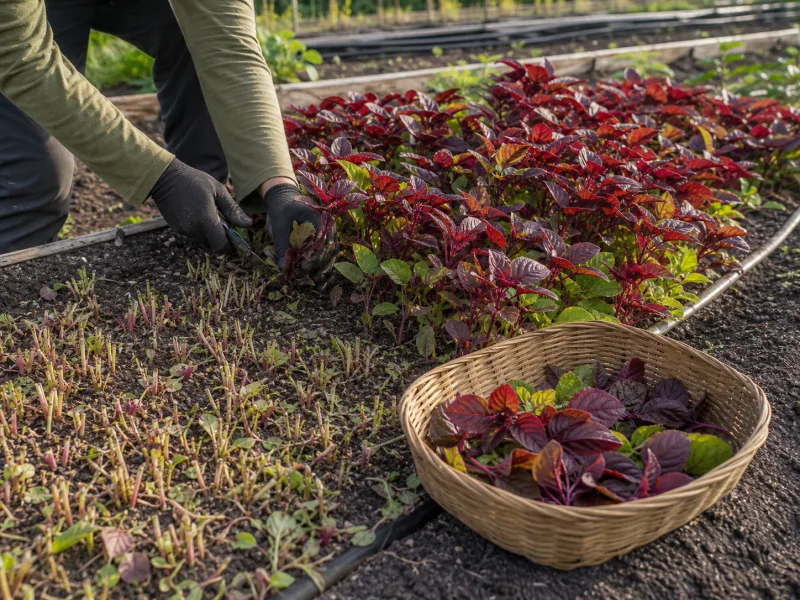
Leave one part of the bed deliberately untouched
An unpicked strip can be more helpful than a mental note. It shows the actual leaf size and color that were present on the same day, under the same weather and watering pattern. When you return, compare the next section to that living reference rather than relying on a date alone.
This also makes unevenness easier to interpret. If one part of the bed is slow but the plants there are evenly small and upright, it may simply need more time. If plants are crowded, pale, or consistently held back in one area, the pattern is easier to spot when a neighboring strip has not been cleared at the same time.
Use the basket as a check, not a target
A small basket can keep a harvest honest. Stop occasionally and look back at both the picked leaves and the bed. Are you taking mostly the size you intended to use, or has the search for a full basket pulled in plants that would have been better left for another pass? This pause is especially useful with fast leafy crops, where a few extra handfuls can change the structure of a short row.
- Choose a section whose larger plants are beginning to crowd their neighbors.
- Leave smaller plants and an adjacent reference strip in place.
- Check whether the cut area is open enough to see what remains.
- Return when the next section has changed visibly, not simply because a calendar reminder appeared.
Let the next picking follow the bed, not the first pass
Red amaranth grows quickly in favorable conditions, but the pace of one strip does not guarantee the pace of the whole bed. After a harvest pass, notice whether the remaining leaves hold their color, whether the spacing still makes sense, and whether the soil surface is easy to inspect. Those simple observations are more portable across gardens than a fixed schedule.
The result is a harvest routine with room for the crop to vary. Rather than treating the patch as one large batch, each pass gives the next one a clearer starting point and keeps the garden useful between pickings.