A tray of broccoli seedlings rarely speaks with one voice. One section may look settled and even, another may be open enough to read every plug, and a third may ask for a second look before it joins the transplant work. Treating the whole bench as one uniform crop can hide those differences just when a grower needs a clear order for moving plants.
The useful task is not to find the single tallest seedling. It is to sort trays into a few understandable groups based on what can actually be seen, then carry that simple memory into the field. That makes the first return walk less about guessing where a difference began.
Look across the tray before lifting a single plug
Start with a broad comparison: one tray against the next, and each tray from one end to the other. Leaf spread, uprightness, open cells, and the way the plugs hold together are all easier to notice before plants leave the bench. None of these observations needs to become a verdict on every individual seedling; they simply show where the work may need a different pace.
A useful reference is the tray itself, not an unusually large plant beside it. When the eye moves across the same kind of tray, a grower can see whether a difference is isolated, repeated, or only apparent from one angle. That distinction is worth carrying forward.
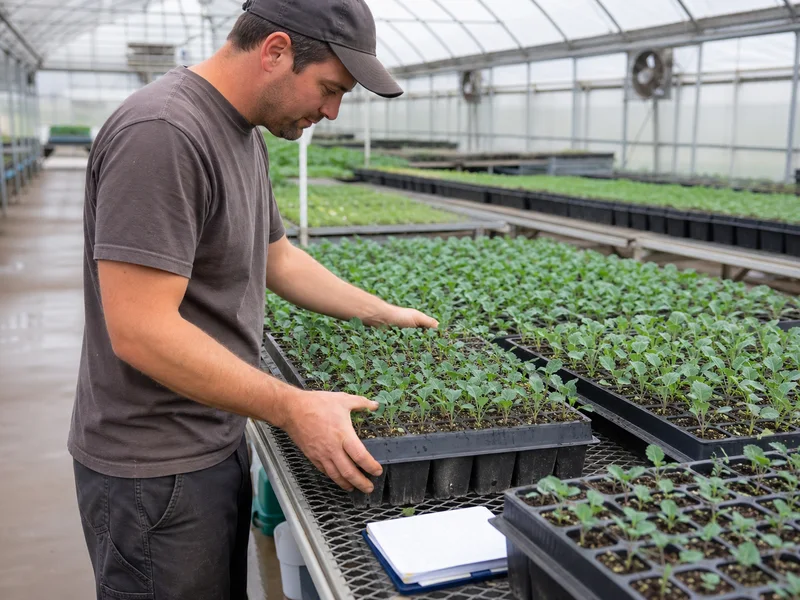
Give each group a working purpose
Groups are more useful when they describe an action rather than a grade. One group may be ready to move in the first pass, another may be kept together for a later pass, and another may simply need a closer look before its place is decided. The point is not to create a perfect ranking. It is to avoid mixing every tray together and losing the reason a grower paused over it.
A bench location, a tray row, or a short note can be enough to keep that distinction visible. The record should be light enough to use during real work, while still allowing the same group to be found again after the nursery bench is empty.
Keep the tray order when field work begins
Once transplanting starts, it is tempting to scatter every group into the same rhythm. Keeping a simple sequence instead gives the field a little context: which trays went first, which were held back, and where a particular group was placed. That is not a performance claim. It is a way to make the next observation specific.
The first-week broccoli root-zone guide focuses on the early field check after plants have moved. A tray grouping made beforehand gives that later visit a clearer starting point, because the grower can compare a known group rather than an anonymous section of the bed.
Return to a group, not just a problem
The most useful follow-up is often a return to one chosen group, not a walk that waits for an obvious problem to announce itself. Look again at the trays or field section that stood apart before transplanting. Did the difference still make sense once the plants were moved, or did it disappear when seen in a new setting?
Broccoli seedlings do not have to look identical to be ready for careful work. A grower only needs a way to see the variation, keep it understandable, and revisit it without reconstructing the whole nursery story from memory.