A large watermelon is not automatically a well-finished watermelon. Flavor and texture depend on whether the plant carried fruit with enough healthy leaf area and whether water management stayed calm as the fruit approached maturity.
Give each plant room to declare its strength
Crowded watermelon stands make it difficult to tell which vine is feeding which fruit and encourage a tangle that cannot be checked later. Spacing is a management decision, not simply a planting-rate choice.
Trace a few main vines from the crown to the fruit. If they cannot be followed without moving several neighboring plants, the stand is too congested for accurate crop decisions.
Read fruit set against vine condition
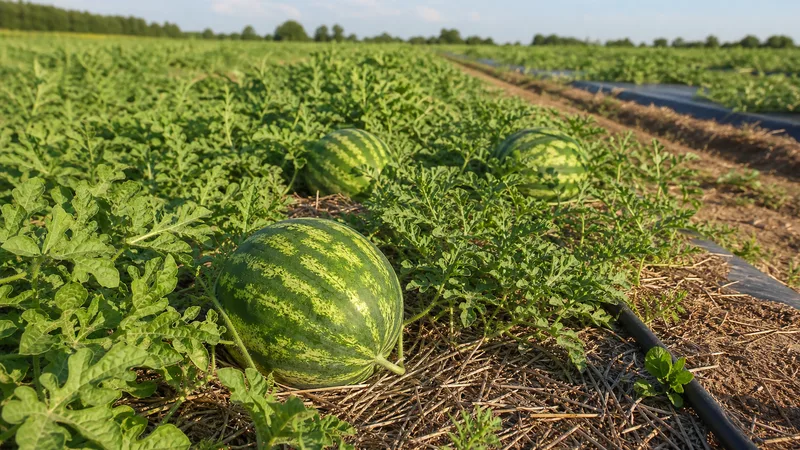
A plant with pale, stressed, or weakly expanding vines should not be judged by fruit number alone. Retain fruit where the vine can support it and avoid assuming every early set deserves to remain.
Compare the leaf size and color around each retained fruit. A fruit sitting beyond a weak section of vine needs a more cautious expectation than one supported by active foliage.
Avoid abrupt water changes in the finishing period
As melons size up, large wet-dry swings can change texture and make maturity harder to read. The target is a stable root zone, not a constantly wet surface.
Use a hand probe below the vine canopy. Check whether moisture is consistent at root depth rather than deciding from cracked or darkened surface soil.
Use several ripeness signals together
Ground spot color, tendril condition, rind feel, and the crop calendar can all help, but none should be used alone. Compare fruits from the same block and open a small test sample before committing a large harvest pass.
Record which signals matched the best-eating test fruit. That note is more valuable next season than a universal rule based on a single visible sign.
Fruit-set choices are examined in the watermelon fruit-set guide. For a separate ripeness workflow, see the watermelon harvest-window guide.
Watermelon quality becomes more predictable when fruit size is treated as one observation among several, not the final answer.