A winter melon grown on the ground eventually becomes too heavy to treat like just another part of the vine. Once the fruit has settled into a position, the question is less about making the field look neat and more about whether that particular melon has a clean, stable place to rest.
Ground-grown vines can cover a surprising amount of soil. Fruit may end up against damp earth, beneath a tangled leaf layer, or where every inspection requires lifting and turning it. A small prepared resting place gives the grower a way to check one fruit without disturbing the whole section around it.
Choose the resting place before the fruit becomes hard to move
For a melon that will stay on the ground, start when it is still possible to see the vine, the fruit, and the surrounding soil as one picture. Look for a place that is reasonably level, not directly in the path of routine foot traffic, and not where water naturally gathers after ordinary irrigation or rain. The aim is not to prescribe one material or one setup for every field. It is to make the contact point visible and manageable.
A clean pad of dry plant material, a suitable support, or another simple field-safe separator can help keep the fruit from resting directly on wet soil. What matters is that the support remains stable rather than becoming another place where moisture and debris collect.
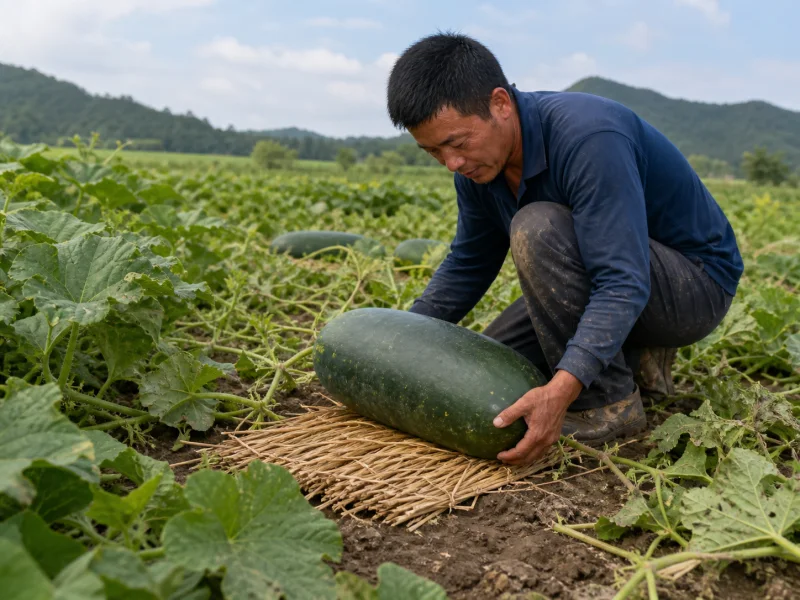
Move the fruit once with a reason, not often out of habit
Frequent turning can make a fruit harder to read because the stem, vine position, and contact mark keep changing. When a change is needed, support the fruit carefully, settle it onto the prepared surface, and then leave a clear reference point for the next check. The surrounding vine should not have to be pulled tight simply to make the fruit look centered.
After that, the useful work is observation. Is the resting place still clean? Has the melon remained level? Are leaves or loose soil now covering the point where it touches the support? These small questions are easier to answer when the fruit is not being moved at every visit.
Keep a narrow viewing path through the vines
A ground-grown winter melon does not need an exposed, bare field around it. It does need a route that lets someone return without stepping across the fruit or dragging vines aside. Keep enough space to approach from the same side and to see the fruit, its support, and the nearby vine connection together.
This is especially useful when several fruits are developing at different stages. A familiar approach path helps distinguish a real change in one fruit from a change caused by the last inspection. It also makes it less tempting to reach into the canopy and shift whatever is closest.
Let the contact point remain part of the record
The underside of a ground-grown fruit is not something to ignore until harvest. Its resting place is part of the field condition. Return occasionally, clear loose debris only when it is actually obscuring the view, and keep the support doing one simple job: separating the fruit from a problem contact surface without making the fruit harder to inspect.
- Prepare a stable resting place while the fruit is still easy to position.
- Keep the fruit and nearby vine relaxed rather than forcing a new shape.
- Use the same approach path for the next inspection.
- Check the support and contact area before deciding that the fruit itself has changed.
For ground-grown winter melons, a resting place is a small field decision with a long useful life. It keeps the fruit easier to see, the vine easier to leave alone, and the next visit more informative than the last.