Bitter melon becomes hard to manage when the trellis fills before the crop’s work pattern is defined. Flowers, young fruit, laterals, and harvesting hands all need room in the same vertical space.
Build a trellis that can be inspected from both sides
Support should keep vines off the ground and leave a visible fruiting zone. A dense wall of growth makes pollination observation, fruit grading, and harvest slower than it needs to be.
Stand on both sides of the row. You should be able to see into the lower and middle canopy without pulling large sections of vine aside.
Guide laterals before they cross and shade one another
Early directional work keeps productive growth separated and prevents the center of the trellis from becoming a permanently humid tangle. Remove only what blocks access or creates repeated overlap.
Follow a few laterals back to the main vine. If their origin and fruit positions cannot be identified, the trellis needs a lighter, earlier pass.
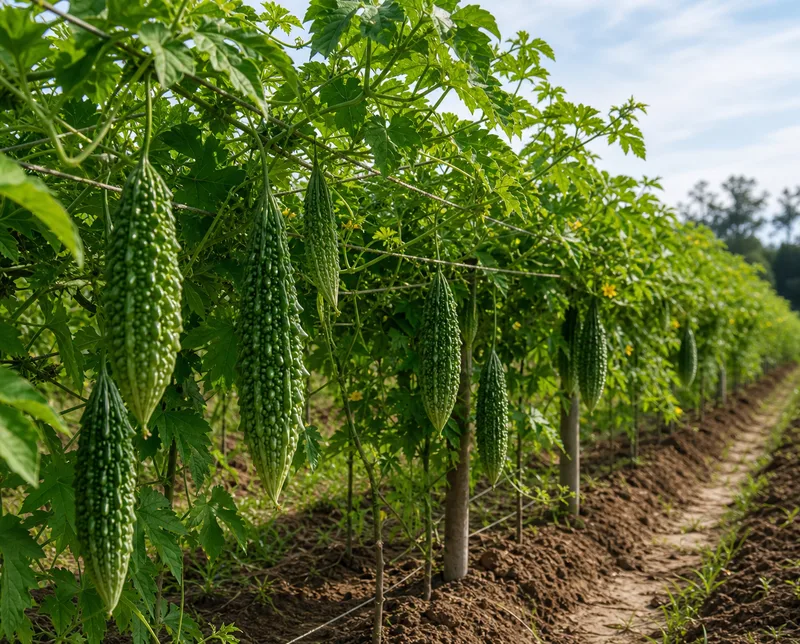
Observe flowering and fruit set in the actual canopy
Fruit set depends on conditions around the flowers, not just a count of blooms. Weather, airflow, and the distribution of active growth should be considered before retaining every developing fruit.
Check flowers at different heights and sides of the trellis. Note whether the crowded center behaves differently from the open outer rows.
Pick before fruit becomes a hidden load
Bitter melon changes quickly once it reaches market size. Frequent harvest keeps fruit visible and reduces the chance that overmature fruit stays hidden behind leaves.
Make a test picking pass through a dense section. If ripe fruit is being found only after moving vines, alter training rather than accepting missed harvests.
Use the bitter melon trellis guide for the airflow and access pass. Flowering-stage checks are in the fruit-set guide.
A useful bitter melon trellis leaves no mystery about where the next flower, fruit, and harvest pass will happen.