Late-season corn is easy to misread from a distance. Large ears, drying husks, and older leaves can make a field look ready, but harvest timing depends on use, kernel maturity, ear uniformity, and whether the field is dry enough to work.
If early emergence was uneven, maturity usually will not be perfectly even either. This connects directly with corn stand uniformity and early emergence checks: the gaps that start early can carry through tasseling, grain fill, and harvest decisions.
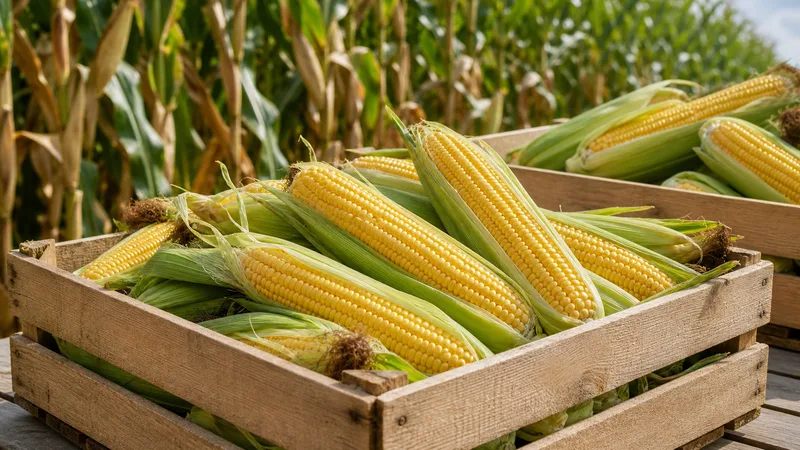
Start with the harvest use
Corn harvest timing starts with the intended use. Fresh eating corn needs a narrow window when kernels are full but still tender. Grain corn needs a later window when fill is more complete and drying has progressed. Mixing those goals leads to either early harvest or unnecessary delay.
For small plantings, this decision matters even more. Fresh eating corn may need several passes instead of waiting for the entire patch. Corn kept for dry grain or feed needs a wider view of field maturity and drying conditions.
Dry husks are only one clue
Husk and silk color are useful signals, but they should not be the only harvest test. Dry husks do not prove that every ear has reached the same maturity, and dark silks do not guarantee full kernel development.
A better check is to sample ears from several parts of the field: edge, middle, low area, and weaker rows. Open the husk and look at kernel fill, tip fill, ear size, and how firm the kernels feel for the intended use.
Late moisture affects fill and standability
Late-season corn is not simply waiting for harvest. Dry stress during grain fill can reduce kernel development, while prolonged wetness can weaken the root zone and make field access harder. The goal is to let the crop finish without creating a field that is difficult to harvest.
The same late-season discipline appears in soybeans, where soil swings after flowering affect pod set and maturity. The crops differ, but both need a balance between fill, root condition, and harvest readiness.
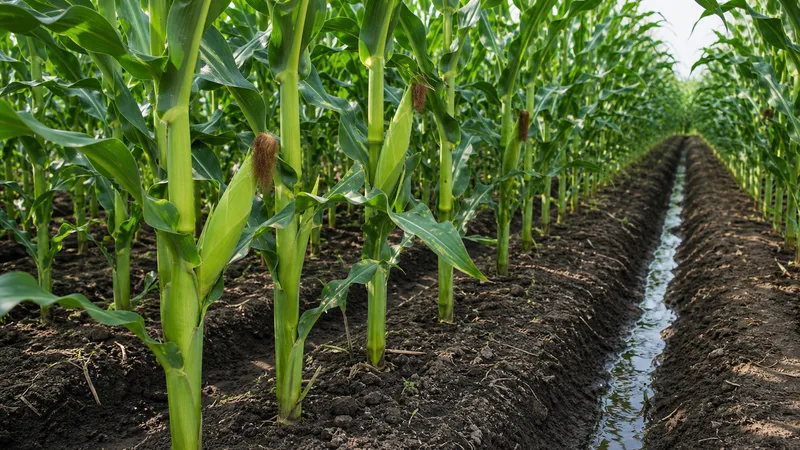
Judge lodging risk before harvest day
If wet soil or wind arrives near harvest, lodging risk can rise quickly. Once corn is down, harvest becomes slower, ears can be dirtier, and losses are harder to avoid. Before harvest, check stalk firmness, root hold, and wet spots that may not support traffic.
When maturity is uneven, the decision is usually a balance between quality, weather, and field access. Waiting for every plant to match is rarely realistic, but harvesting from the earliest patch alone can lead to poor judgment for the rest of the field.
Sort the harvest before blaming the variety
After harvest, separate ears by maturity, tip fill, damage, and intended use. Do not judge the crop from one mixed pile. Sorting makes it easier to see whether the issue came from planting date, stand uniformity, moisture, density, or the harvest window.
Field crops often share this kind of harvest logic. Wheat maturity checks also depend on weak field edges and grain dryness, while corn requires ear maturity, stalk condition, and post-harvest use to be read together.
Record the window, not only the date. Which part of the field matured first, where lodging began, and where ear tips were poorly filled will help more next season than a single harvest date.