A soybean field can look strong from a distance and still finish unevenly. The useful question is not which individual plants look biggest. It is whether the stand emerged evenly, whether gaps are clustered, and whether the podding layer is consistent across the field.
This is a common field-crop problem. Once the early stand is uneven, later management keeps working around that pattern. The same idea appears in corn emergence, where even stands matter more than tall individual plants. Soybeans can branch more than corn, but a few strong plants still cannot repair a weak field pattern by themselves.
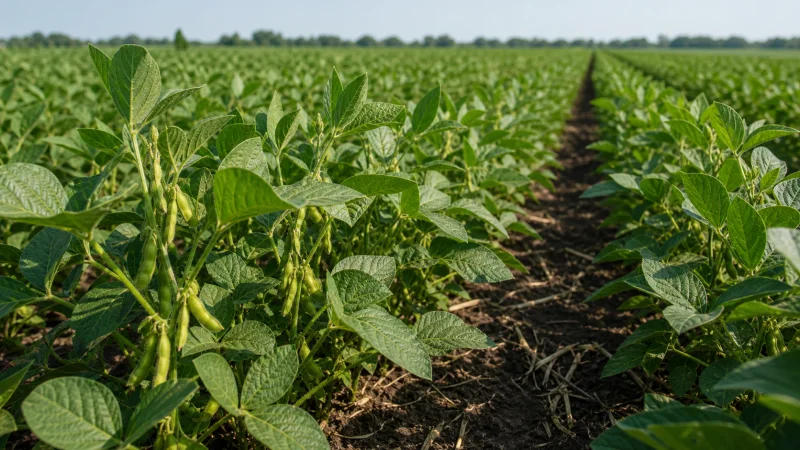
Check gaps before judging the best plants
Soybeans are easy to misread early. A few vigorous plants can make the field look active, while gaps, delayed seedlings, or weak patches quietly reduce the final stand. Field edges, compacted spots, and low areas often show the first signs of uneven growth.
After emergence, do not only count plants. Look at whether the row is continuous, whether spacing is roughly even, and whether weak seedlings are clustered. Scattered gaps can be partly compensated by branching. Continuous gaps or a large weak patch usually cannot.
Row spacing should support light and pod position
If soybean density is too low, the canopy closes slowly and the soil surface stays exposed longer. If it is too high, leaves shade each other, lower pods may be weaker, and lodging becomes more likely. Useful spacing supports a stable canopy while still allowing light and air to move through the rows.
In small plots, the common mistake is judging the crop by how quickly leaves cover the ground. Soybeans are not leafy vegetables. A thick canopy does not automatically mean better pod fill. The middle and lower plant structure still needs enough light and room to stand.
Branching helps, but it does not erase a poor start
Soybeans can branch, so small gaps are not always a crisis. But branching does not fix emergence that happened over a long window, and it cannot turn a weak patch into a uniform high-performing stand.
If plant size is already very mixed early in the season, later checks should focus on the whole stand instead of the largest plants. Strong plants may carry more leaves and branches, but weak plants often stay behind during pod setting and maturity.
After flowering, avoid sharp soil swings
During flowering and pod setting, soybeans respond strongly to soil moisture swings. Long dry periods can reduce pod set and seed fill, while extended wetness can leave the root zone short of air. A fixed calendar is less useful than watching soil condition, weather, and the crop together.
Another legume shows the same caution from a different angle: peanut fields can hide soil problems behind strong leaves. With soybeans, the above-ground canopy also has to be checked against node position, pod layer, and seed fill.
Lodging and uneven maturity usually start earlier
Soybean lodging does not always come from one sudden event. High density, poor light inside the canopy, weak stems, and late moisture pressure can all make plants less able to hold a heavy pod load. Once lodging happens, airflow, light, and harvest efficiency all suffer.
Uneven maturity often follows uneven emergence. Plants that started at different times or grew through different soil conditions rarely finish together. Before harvest, do not judge the whole field from the yellowest patch or the greenest patch alone.
Sample the pod layer before harvest
As soybeans approach maturity, pull sample plants from different field positions: edge, middle, low spot, and higher ground. Look at pod height, pod distribution, seed fill, and maturity consistency. Field color from a distance can miss green pockets or overly dry patches.
Keep field-position notes for next season. The most useful soybean record is not only which variety looked good. It is where gaps appeared, where lodging started, and where maturity lagged. Those location notes make the next planting decision much more practical.