Rice transplanting is often judged after the field is planted, but many problems begin in the nursery. Seedlings that were crowded, stretched, waterlogged, or lifted before their roots held together may survive the move, yet they usually settle slowly and create an uneven stand.
The main rice growing guide looks at field leveling, water depth, and later crop rhythm. This page stays earlier in the crop: the nursery bed or tray, seedling density, daily water, ventilation, and the final hardening period before seedlings leave for the field.
A good rice nursery is even before it is impressive
Strong rice seedlings do not have to be the tallest seedlings in the nursery. The better sign is even growth across the bed or tray, a steady green color, and roots that hold the medium without becoming a hard tangled mat. When one side of a nursery is wet, shaded, or thickly seeded, the seedlings from that area will not behave the same after transplanting.
That is why nursery preparation should start with a flat surface, clean workable medium, and a seed layer that can be distributed evenly. A grower can correct a few empty spots early, but a dense patch is harder to fix later because it competes for light and produces thin plants.
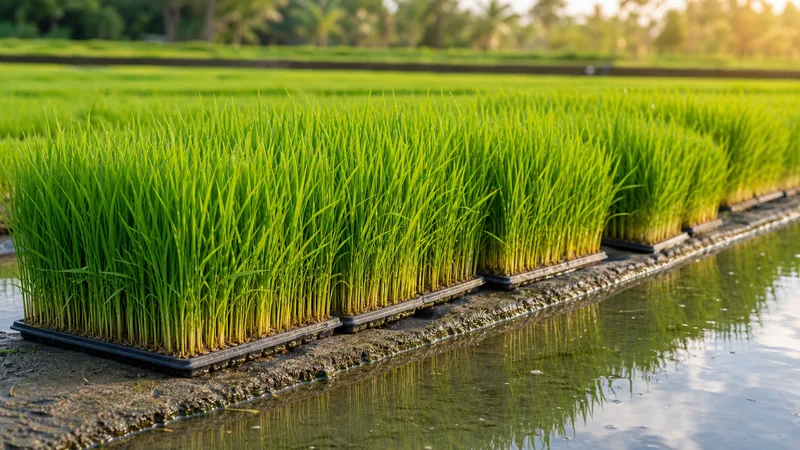
The medium should hold moisture without sealing the roots
Rice seedling media need two jobs at once. They must keep enough moisture around germinating seed, and they must still let young roots breathe. Heavy, sealed, or poorly leveled media can leave some seed too wet while other parts dry at the surface.
For tray or mat seedlings, the medium also needs to release as a stable root block. If it falls apart during lifting, young roots lose contact and the transplanting operation becomes rough. If it is packed too tightly, seedlings may look neat in the tray but have weaker root activity when moved.
Seeding density changes root strength and recovery speed
Dense seeding may look efficient, especially when tray space is limited. The risk is that seedlings compete too early, leaves stretch, and roots knit into a thin crowded layer. Those seedlings are harder to separate, harder to plant at a consistent depth, and slower to resume growth.
A slightly more even stand usually pays back during transplanting. The goal is not to produce the maximum number of stems per tray; it is to produce seedlings of similar size that can be lifted, carried, and planted without a long recovery pause.
Nursery water should be steady, not constantly deep
Young rice needs dependable moisture, but nursery management is not the same as keeping seedlings under deep water all the time. Long saturated periods reduce air around the roots and can leave seedlings soft. Repeated drying does the opposite, forcing uneven emergence and weak root contact.
Check the nursery surface and the bottom of trays, not only the water around them. A surface that looks dry may still have moisture below, while a tray standing in water can still have dry corners if it was not filled evenly. Small checks prevent a nursery from drifting into stress before symptoms become obvious.
Light, temperature, and airflow keep seedlings compact
Rice seedlings become difficult to handle when they grow tall faster than their roots develop. Warm, closed, low-airflow nurseries can make plants stretch. Good light and planned ventilation help seedlings stay shorter, sturdier, and more balanced.
Ventilation should not be treated as an emergency step only after seedlings look weak. It is part of hardening. As transplanting approaches, seedlings should gradually experience more outside air and slightly firmer conditions so the move to the field is not a sudden shock.
Transplant readiness is a root, leaf, and field decision
Seedlings are ready when they can be lifted cleanly, hold together well enough for the planting method, and still have flexible young growth. Leaf stage matters, but it should be judged together with root condition, seedling height, weather, and whether the field is ready to receive them.
If the field is not level or water depth is hard to control, even good nursery seedlings can lose their advantage. That connection is why early nursery checks should be paired with field preparation, and why the later rice water and harvest guide should be seen as the end of the same management chain, not a separate issue.