On a dragon fruit post, the crown can become impressive long before it becomes easy to understand. Branches spill over the ring, fruit begins to appear, and one post can look full at a glance. The useful question is quieter: can you still see how the branches are sitting on the support?
Start from the post, not the outermost branch
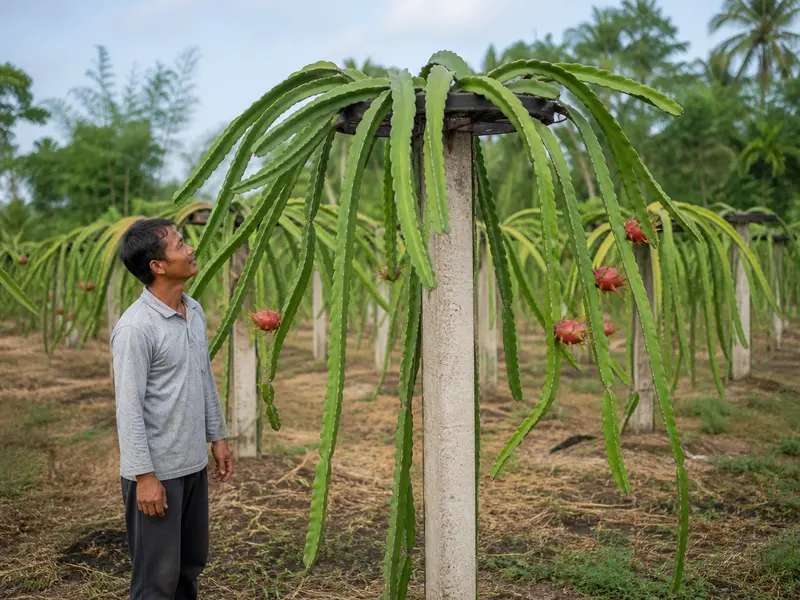
Stand where the post, the training ring, and the first layer of hanging branches can be read in one view. This gives a better reference than looking only at the longest or heaviest stem. A crowded outer edge may be noticeable, but the part that determines whether the crown stays manageable is usually closer to the centre.
Look for branches that have a clear route over the support and for places where several segments are hiding the same point of the frame. The goal is not to make the crown look sparse. It is to keep its structure visible enough that later changes are deliberate rather than reactive.
Let the hanging layer remain distinct
A dragon fruit crown often reads more clearly when the hanging branches are not all treated as one curtain. From the ground, notice whether the lower layer has separate lines, whether fruiting areas can still be found without lifting every branch, and whether the support itself is still visible where it needs to be.
This is a useful observation during ordinary orchard walks. It does not require a fixed seasonal calendar or a rule that every post should carry the same number of branches. Different posts can develop at different rates; what matters is whether each one can still be inspected on its own terms.
Return to the same side before changing direction
Pick one side of a post as a repeat viewpoint. On the next visit, look at the same place: the centre of the ring, the first branches over it, and the space below the crown. A repeatable angle makes it easier to tell whether a branch is simply extending or whether the working view of the post is disappearing.
When a change is needed, this reference helps separate an actual structural issue from the natural fullness of a productive plant. It also makes follow-up simpler because the post has a clear before-and-after position rather than a general memory of looking busy.
A small field note is enough
- Can the central support and training ring still be seen?
- Do hanging branches form readable, separate paths?
- Can fruiting areas be checked without pulling the crown apart?
- Is the same view still useful on the next orchard walk?
Keeping a dragon fruit crown readable is not about forcing uniformity. It is about preserving a practical view of the structure that holds the plant, so decisions can be made with the post, branches, and fruiting space all in sight.