Once a raspberry row has finished its main crop, the canes can look like one tangled mass: brown stems with empty fruiting laterals, green shoots rising from the base, and a trellis that has become hard to read. The useful next step is not to make the row look tidy as quickly as possible. It is to separate the canes that have completed their work from the ones that will build next season’s structure.
This guide is for a summer-fruiting system in which the main crop is carried on older canes. Primocane-fruiting and double-cropping systems are managed differently, so confirm how the cultivar is intended to fruit before applying any removal pattern. The same field can hold more than one cane age, but the role of each cane should be clear before a cut is made.
Read the fruiting history before reaching for shears
Start at the base of a cane and follow it upward. A spent fruiting cane often shows the remains of lateral branches where fruit was carried and may be drying or browning after the crop. A replacement cane is usually vigorous, green, and growing from the crown or row base without the same completed fruiting pattern. Do not rely on colour alone; trace the cane and look for the evidence of where it fruited.
Work one short section at a time. When old and new canes cross, gently move them apart rather than pulling them through the wire. This makes the next decision easier and protects the new growth that the row will depend on after the old fruiting wood is gone.
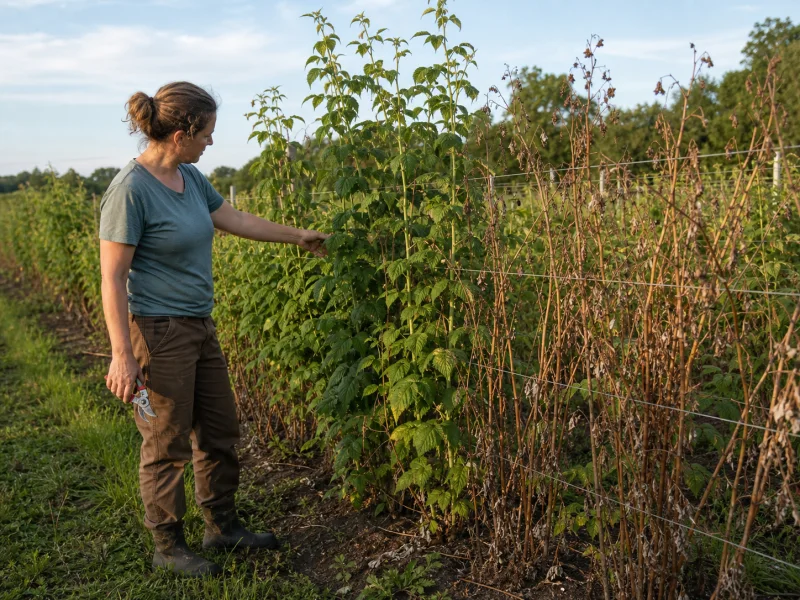
Remove spent canes only after they are positively identified
In a summer-fruiting system, old canes can be removed after the main harvest once they are clearly distinguished from the replacement growth. Cut them close to the base without tearing at the crown or snagging nearby green canes. Take removed material out of the row so the trellis, walking lane, and remaining growth can be seen again.
The aim is not to thin every cane to the same visual pattern. It is to stop the completed fruiting wood from competing with the new framework. A clean, deliberate removal is more useful than repeated minor cuts that leave stubs, tangled laterals, and uncertainty about which canes are still meant to grow.
Choose a workable set of replacement canes
After the old canes are out, look at the new ones as a group. Keep the well-placed, healthy canes that can be supported without crowding each other; deal with weak, damaged, or badly positioned growth according to the row system and local recommendations. The number of canes to retain is not universal. It depends on cultivar, vigor, spacing, and the trellis design.
Avoid shortening healthy new canes simply to make the row look even. First give them a clear route through the support wires, then assess whether the row still has light and access. A few canes placed deliberately are easier to inspect later than a dense wall that was left because every green shoot looked valuable.
Restore access without turning the row into a bare corridor
Post-harvest work is also a good time to look at the ground between rows. Check that irrigation lines are visible, water can move away after rain, and the walking side does not require brushing through the new canes. Keep the soil and row cover consistent with the growing system, but do not use access as a reason to remove productive replacement wood.
The practical goal is a row that can be checked in seconds: old fruiting canes are gone, selected new canes have a place on the trellis, and the base of the plants is still reachable without bending or breaking growth. That clarity is what makes later tying, observation, and harvest preparation less disruptive.
Carry the cane decision into the next season
Before leaving the block, note what made the job difficult. Were the old canes hard to identify because the row was never trained? Did the new canes emerge too densely in one section? Did a weak area correspond with poor drainage or a damaged support wire? These observations are more useful than trying to solve every issue with another cut on the same day.
Raspberry renewal is a sequence, not one pruning event. When the row makes the difference between past fruiting wood and future-bearing canes visible, each later decision has a clearer starting point.