A plum branch can look productive long before the crop becomes heavy. Small green fruit sit close together, sometimes in pairs or clusters along the same short section of wood. As they enlarge, the decision changes: how many can this particular branch carry, and is there enough room for the fruit that remains?
Thinning means removing some young fruit by hand while leaving the tree's fruiting wood in place. It is most useful where set is heavy. A tree carrying only a scattering of plums after poor flowering or frost may need observation instead of a full thinning pass.
Start with the tree, not the heaviest cluster
Walk around the tree before removing anything. Compare a strong, well-supported branch with a thin outer branch, and look at the crop throughout the canopy. A crowded cluster does not necessarily mean the whole tree is overloaded; equally, fruit spread over many small branches can add up to a substantial crop.
The kind of plum matters. University of California guidance notes that Japanese-type plums often set heavily, while European plums generally need less extensive thinning unless the crop is particularly dense. These are tendencies, not a substitute for looking at your own cultivar, tree age and actual fruit set.
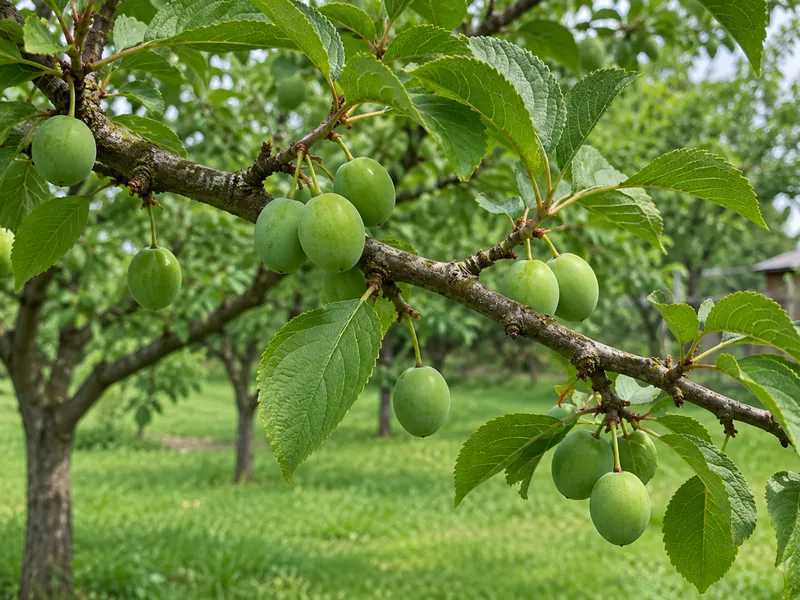
On a young tree, be especially conservative about load on narrow limbs. If the crop is light, leave healthy fruit and move on. If several clusters are crowded and outer branches are already carrying many fruit, mark those sections for a closer pass rather than deciding from the biggest cluster alone.
Balance early thinning against natural drop
Removing excess fruit while it is still small gives the remaining crop more time to respond. Waiting until branches are bending under almost mature plums can still relieve weight, but it is late to expect the full benefit for fruit size. Penn State Extension discusses early thinning as a way to manage both fruit size and branch load.
The difficulty is that a tree may shed some young fruit naturally. Oregon State University's fruit-thinning guide suggests allowing for some natural drop when deciding the final number. The familiar name “June drop” describes a seasonal event in some regions, not a June date to copy into every climate.
Where recent frost or uncertain fruit set makes losses hard to judge, inspect the tree before committing to a final spacing. Fruit injured by cold can drop later; UC IPM describes how internal browning can help identify cold-damaged young stone fruit. If you are unsure what survived, leave some margin and recheck promptly. Waiting indefinitely has its own cost, so use local advice for the cultivar and conditions rather than a fixed number of days everywhere.
Make room along the branch
Begin with damaged, obviously misshapen or closely touching fruit, then work along the branch instead of removing every second plum by eye. Support the twig with one hand and carefully pinch or clip an individual fruit stem with the other; do not pull hard enough to tear off the short fruiting spur. Step back occasionally to see the branch as a whole.
Extension guides offer different starting distances. The University of California suggests roughly 4–6 inches (10–15 cm) for heavily set plums; Oregon State describes about 6–8 inches (15–20 cm). Fruit size, cultivar, branch strength and local conditions all influence the final choice. Use those ranges to begin assessing a heavy crop, not as an exact rule for every plum or a reason to strip a lightly bearing tree.
Spacing is measured along the branch, but branches also differ in strength. A narrow outer shoot carrying several fruit may need a lighter load than a sturdy interior limb. A good result leaves sound fruit with room to enlarge and avoids leaving all the weight at the tip. This is the same kind of whole-branch judgment involved in managing a pear tree's fruit load, although pear spacing and pruning decisions should be made for that crop.
When the fruit crowds a branch tip
Imagine a branch with several close clusters near its end and two isolated plums farther in. There is no need to remove the inner fruit simply because you have started thinning. Check the crowded tip first: remove damaged fruit, then select sound ones with enough space between them. A slender tip may need fewer remaining fruit than the stronger wood closer to the branch's base.
Look from the other side before moving on. Leaves can hide fruit, and two plums that appear well separated from one angle may be touching behind the branch. After working on a couple of representative limbs, pause and look at what remains across the tree. If the crop is uneven or frost damage is uncertain, that pause helps you avoid treating a sparse section like the heaviest one.
Revisit the load as plums grow
After the first pass, note how much fruit remains and check again after further natural drop. If a thinned branch becomes crowded as the fruit grows, or a young limb begins to bend sharply, reduce the load carefully or seek local advice on support. Do not push a brittle branch upright by force.
Keep the tree watered according to soil moisture and drainage; removing fruit does not repair drought stress or a damaged root system. If a branch is cracked, fruit is repeatedly falling with dark internal tissue, or the tree looks unhealthy, treat that as a separate problem rather than thinning harder. Take photographs and consult a local fruit-growing adviser when the cause is unclear.
A successful pass can look surprisingly spare when the fruit is still small. What matters is not a bare tree or a uniform-looking pattern: it is a crop distributed across healthy wood, with enough retained fruit for the tree and the grower.