Onions can look promising for a long time before the real problem appears. A bed of green tops may still finish with small bulbs, uneven sizes, thick necks, weak skins, or bulbs that do not cure well.
The reason is that onion quality is built before the bulb is obvious. Seedling strength, spacing, light, and water rhythm all shape the crop early. For another allium comparison, garlic stand uniformity and planting-piece consistency show the same basic lesson: uneven starts often become more visible at harvest, even when the crop itself is different.
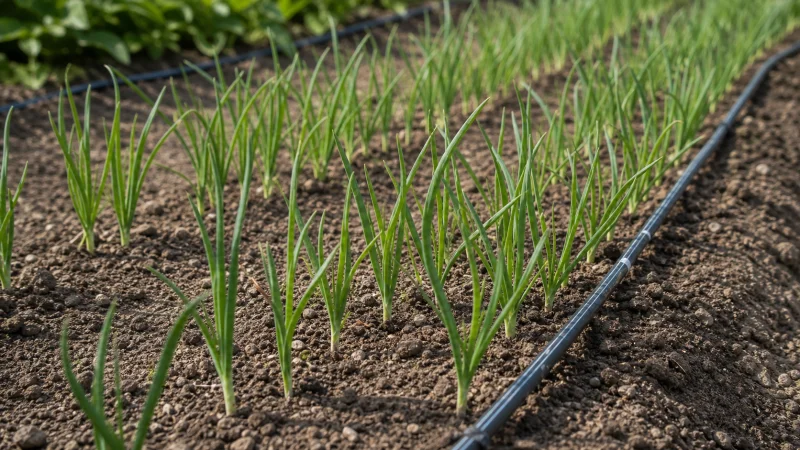
Build steady seedlings before chasing heavy tops
Weak seedlings rarely make strong bulbs, but heavy top growth is not the only goal. A useful onion stand has upright leaves, active roots, open row space, and enough airflow around the plants. A bed that looks full too early may simply be too crowded.
Transplants should not be set too deep, and the growing point should stay clear of soil. Direct-seeded rows need early attention to gaps and clusters. In a small garden, delaying thinning often feels harmless, but the bulbs need room later. Too many plants can turn one promising bed into many undersized bulbs.
Bulb size starts with the leaves already made
An onion does not wait until bulbing begins to decide its potential. Each healthy leaf helps support the bulb that forms later. If the plant enters the bulbing stage with too few leaves, weak light, or repeated water stress, it cannot suddenly make up all of that lost growth.
More leaves still need space. When plants are too close, leaves shade each other, the bed stays damp, and maturity becomes uneven. The better target is a canopy that catches light while the soil surface can still breathe.
When day length changes, spacing mistakes show up
Onion bulbing is tied to day length. If plants are too small when conditions favor bulb formation, the bulbs often stay small. If the stand is too dense, expanding bulbs begin to compete and the size spread becomes obvious.
That is why onion timing should not be reduced to one calendar date. Seedling age, leaf count, season, light, and bed condition have to line up. In a home garden, smaller plantings are easier to manage than one crowded block. When buying transplants, avoid batches with very mixed stem sizes, because they rarely mature together.
Keep water steady, then let the necks dry
Onions have a relatively shallow root system, so they need steady moisture while leaves are being built. Later, as bulbs finish, constantly wet soil can keep necks soft and skins slow to dry. That affects curing and storage quality.
This is a different crop from carrots, but the management idea connects: carrot root shape is strongly affected by early soil condition and moisture swings. Onions are not straight-root crops, yet they also dislike early stress and late wetness. The late-season difference is that onion necks and skins need time to dry down.
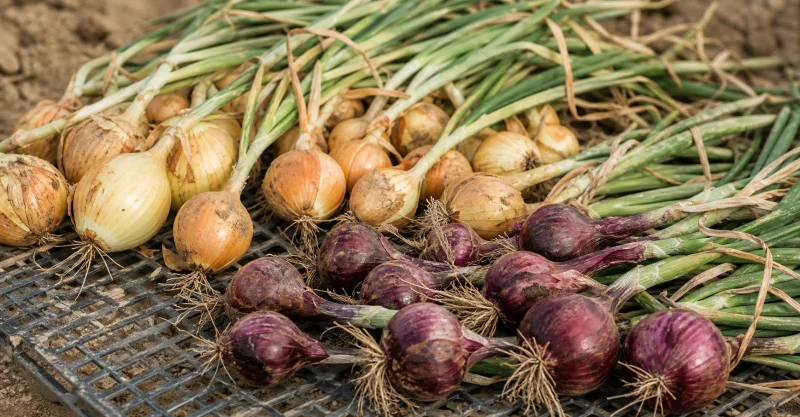
Falling tops are only one harvest signal
Top fall is useful, but it should not be the only harvest signal. If plants remain wet after lodging, necks and skins can deteriorate. If bulbs are lifted too early, the outer skins may not be ready and curing takes longer.
A better habit is to pull a few sample bulbs as the crop approaches maturity. Check bulb size, neck softness, skin development, and soil moisture. Whenever possible, lift onions when the surface is dry enough that bulbs enter curing without a layer of mud.
Curing and sorting explain what happened earlier
After harvest, onions should not be piled too thickly. They need air movement, rain protection, and enough time for necks and skins to dry. If tops are left attached, avoid heavy matting. If tops are trimmed, do not cut too close to the bulb.
Sorting is more than cosmetic. Separate large bulbs, medium bulbs, small bulbs, thick-necked bulbs, and bulbs with weak skins. Many small bulbs point back to spacing, seedling strength, or early moisture. Thick necks often suggest late wetness or uneven maturity. Poor skins often trace back to harvest timing and curing conditions.
The next improvement is not only a new variety. Variety matters, but onion quality depends on a steady stand, enough space, useful light, a good water transition, and patient curing. Those notes are worth keeping before the next planting.