Once asparagus is allowed to make its feathery growth, a bed stops reading like a collection of harvestable spears. The useful view becomes wider: the continuity of a row, the space between plants, and the way the airy stems hold their place across the bed.
This is not a moment for trying to make every plant look alike. It is a chance to choose a repeatable walking view, then let that view show what has changed since the last visit.
Let the row replace the single spear
Begin at one end of the bed and look along a full row before stopping at any one plant. A row gives the eye a reference: where the ferny canopy begins, where it thins, and how the space between neighboring plants remains visible. A plant that looks unusual on its own may simply sit beside a fuller or more open section of the same row.
The goal is not a perfect green wall. The row is useful precisely because it keeps small differences in context.
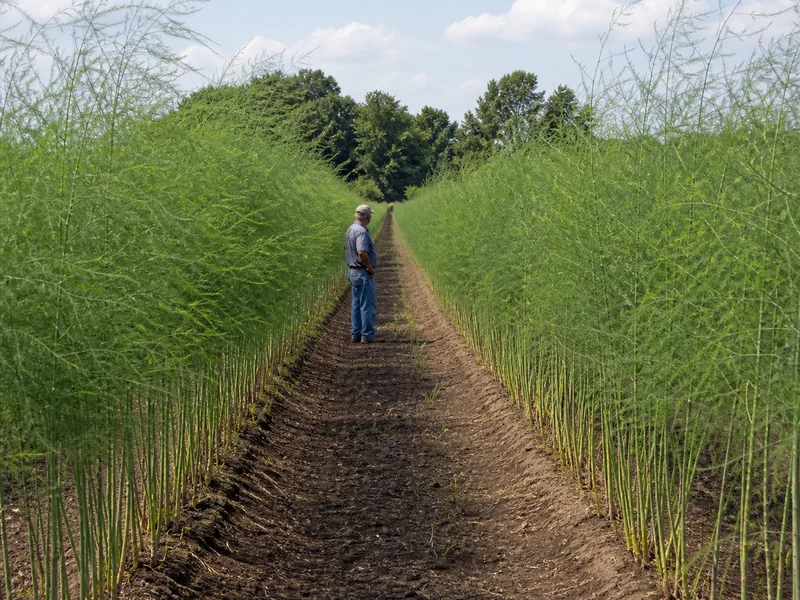
Walk the same gap on the next visit
Choose one aisle or a consistent side of the bed for a slow pass. On a later walk, start from the same end and use the same gap between rows. Repeating the viewpoint makes it easier to notice a change in continuity without relying on a mental picture from another angle.
There is no need to turn this into a rigid checklist. A familiar route is enough: follow the line, pause where the line becomes hard to read, and note whether that place is still the same when you return.
Read the canopy as a working layer
Ferny asparagus changes the visual character of a bed. Rather than asking whether a single stem is impressive, look at what the canopy allows you to see. Can you still trace the row? Is there an open place that keeps drawing your attention? Does the foliage form a continuous field of view or break into separate patches?
These are observation questions, not a promise that one appearance has a single explanation. Their value is that they give the next field walk somewhere specific to begin.
A quieter way to finish the pass
- Can the row be followed from one end without losing its line?
- Do the same gaps stand out when the bed is viewed again?
- Is the aisle still a practical place to stop and look rather than rush through?
- Can one section be described by its position in the row instead of by a vague memory?
When asparagus has shifted into fern growth, the bed asks for a longer view than a harvest pass. A calm walk through the same row gives that view a structure, while leaving room for the plants to be different from one another.