Asparagus is unusual because the same spear can be either today’s harvest or part of the plant’s recovery. A bed may still send up attractive shoots after the main picking period, but that does not mean every new spear should be cut. At some point, the work has to change from collecting spears to letting the plant build the fern canopy that feeds the crown below ground.
The transition is easier when it is treated as a field decision rather than a contest to take one more harvest. Look at the age and strength of the bed, the consistency of new spears, and the condition of the rows together. Then make a clear change in the way the whole planting is handled.
Do not start the same clock in every bed
Newly planted or still-establishing asparagus needs time to develop a strong crown before it is asked to produce repeated harvests. In those beds, leaving spears to grow into ferns is not a missed opportunity; it is the work that allows the root system to store energy. Established beds can support a harvest period, but their duration still depends on plant age, vigor, local conditions, and the season’s growth pattern.
That is why a calendar date alone is a weak signal. Compare beds of different ages separately and follow local production guidance for the cultivar and climate. A bed that entered the season under stress should not be pushed simply because another, stronger row is still producing marketable spears.
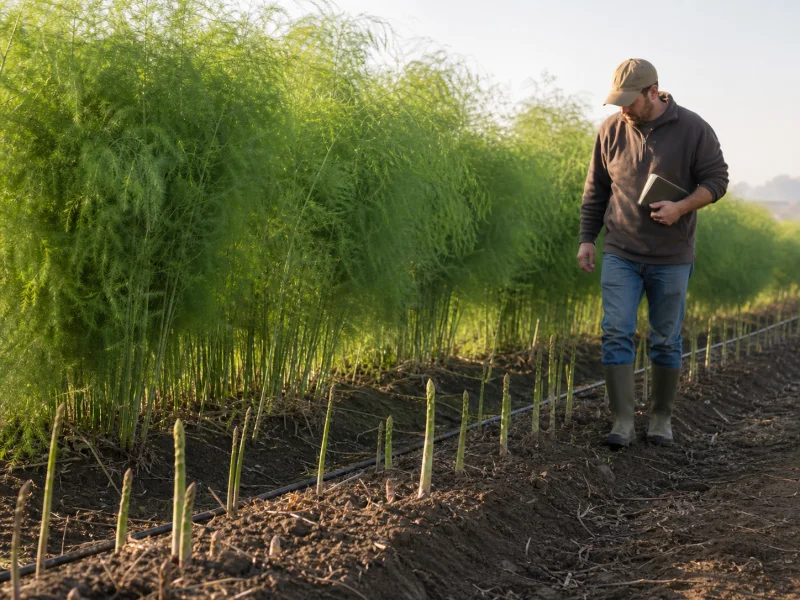
Notice when the harvest pattern is losing strength
The decision to finish picking is usually clearer when you watch a run of harvests rather than one morning. New spears may become noticeably thinner, less uniform, or slower to emerge. The row can begin to look as though it is spending more energy replacing shoots than building the future canopy. No single spear proves that the season is over, but a continuing pattern is worth acting on.
When that pattern appears, avoid the half-change that keeps the bed confused: cutting the largest spears while leaving only the weaker ones. Pick a practical stopping point for the bed or block, then allow the new shoots to stand. The next growth is no longer a partial harvest; it is the fern crop.
Let the first ferns create the next season’s factory
Once cutting stops, emerging spears need to open into their fine, feathery foliage. Those ferns capture light and direct energy back to the crown. They can look untidy compared with a freshly harvested row, but a dense, healthy fern canopy is the visible part of the bed rebuilding itself.
Give that canopy room to develop. Avoid walking through the row unnecessarily, leaning tools against new stems, or treating upright ferns as weeds. If support or access is needed, make the smallest adjustment that protects the standing growth instead of repeatedly moving through it.
Keep water and access checks simple during the change
The shift from harvest does not mean ignoring the bed. Continue to check whether irrigation is reaching the root zone, whether water is draining away after rain, and whether the row can still be inspected without compacting the soil around the crown. Look for clearly damaged, lodged, or unhealthy growth, but do not turn normal fern development into a reason for routine cutting.
The most useful observations are comparative: one row that opens into a full canopy, another that stays sparse, or a patch where water repeatedly settles. These tell you more about the bed’s future capacity than a few extra spears taken late in the harvest period.
Leave end-of-season cleanup until the plant has finished its work
Fern growth should be allowed to mature before seasonal cleanup. When foliage has naturally declined and local seasonal conditions indicate that the bed is entering dormancy, remove old material according to the production system and local disease-management guidance. Cutting green, functioning ferns early takes away the very leaf area the crown is using to rebuild reserves.
A clear handoff from cutting to fern growth makes an asparagus bed easier to manage year after year. The final harvest is not the end of the crop’s work. It is the moment when the next season begins underground.