A broccoli transplant does not need to look dramatic in its first few days. The useful signs are quieter: the plug is sitting at the right level, soil is touching the root zone without forming a hard collar, and the plant is not rocking loose after irrigation or wind. Before the row starts putting on new leaves, it needs to settle into the field.
That first-week work is not a universal fertilizer schedule. It is a short sequence of checks that helps separate normal transplant adjustment from a problem that will leave a permanent gap in the stand. Walk the field more than once, but let the plants and soil tell you what needs attention.
Set the plug at a level the stem can live with
Place the transplant so the root plug is covered and supported, while the growing point and lower leaves are not buried under a mound of loose soil. A plant set too high can dry around the plug or wobble when water hits the bed. One set too deep can hold wet soil against the wrong part of the stem and make early inspection harder.
After planting a short section, check it from the side rather than only from above. The plant should stand naturally, and a light touch at the base should not reveal an open gap around the plug. Firm the surrounding soil gently enough to make contact without pressing the root zone into a dense, sealed lump.
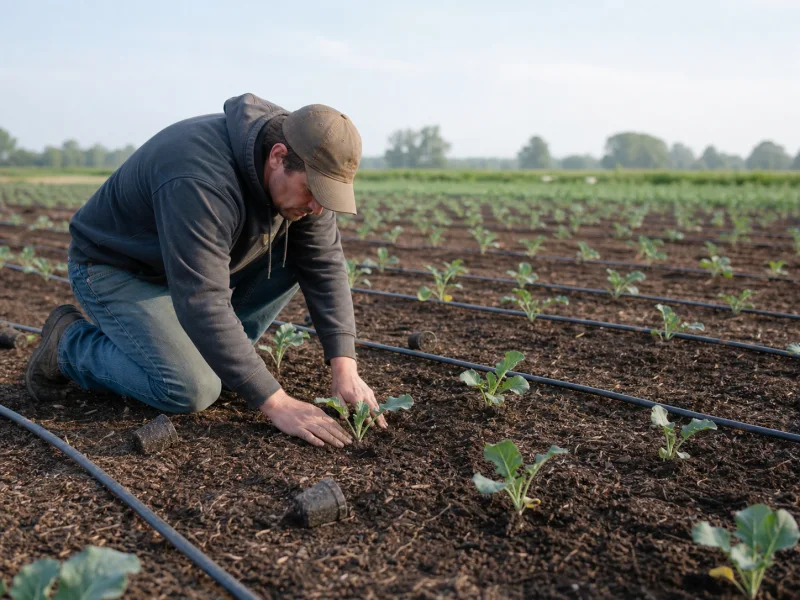
Use the first watering to read the bed
The first irrigation is also a field test. Watch whether water reaches the plants evenly, whether it moves away from the stem instead of pooling there, and whether one end of the row stays much drier or wetter than the rest. A single irrigation run can show a kinked line, a low spot, or an uneven bed long before the plants are large enough to hide it.
Do not respond to a warm-day wilt with automatic extra water every time. First check the soil close to the plug and compare several plants. A transplant can look temporarily tired while the root zone is still appropriately moist; another can look similar because water never reached it. The corrective action should follow the cause, not the appearance alone.
Check the row again after wind or heavy rain
Wind and rain can expose small planting problems quickly. Return after a weather change to look for leaning plants, exposed plugs, soil washed into the center, or leaves resting in standing water. Reset a loosened transplant while the root system is still small rather than waiting for uneven growth to become obvious across the row.
At the same time, avoid repeatedly lifting every plant to inspect roots. A visual check, a light test of stability, and an observation of the soil surface are normally enough. The purpose is to keep the transplant in contact with its new root zone, not to disturb that contact each day.
Decide whether a gap is temporary or real
Not every slow plant needs replacing immediately. Compare it with nearby plants after it has had time to settle, then check for clear damage, an empty plug space, or a plant that cannot regain stability. If a replacement is needed, make it early enough that the new plant still has a reasonable chance to join the row instead of becoming a permanently late plant.
Keep notes mentally or on a field map when weak plants repeat in the same strip. A recurring pattern is more valuable than an isolated gap: it may point to planting depth, water distribution, soil condition, or handling at one point in the operation.
Leave the row readable for the next pass
By the end of the first week, the goal is straightforward. Each plant should have a stable place in the bed, irrigation should be understandable, and the walking route should let you see the root-zone surface without stepping on it. Avoid turning a small establishment check into constant intervention.
Once broccoli transplants have settled, later canopy and head management start from a more even field. The early work is modest, but it prevents the row from carrying avoidable differences into every later stage.