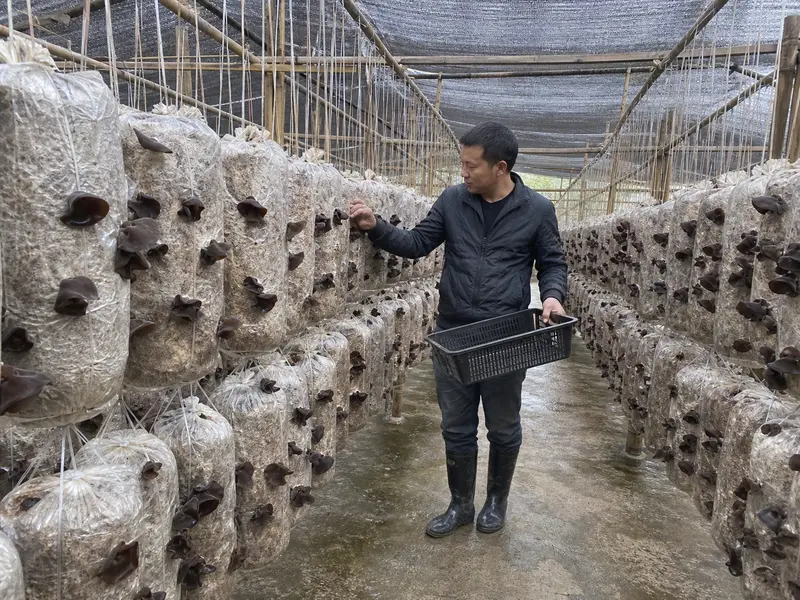
In a bag-grown wood ear mushroom house, harvesting can look like a decision made one bag at a time. In practice, the most useful unit is often an aisle and the full run of bags beside it. A clear path lets a grower see which bags are ready to inspect, where the next pass will begin, and whether the row can still be read without moving through it twice.
Begin the harvest pass at the aisle
Before reaching toward a bag, look down the length of the working path. Notice where the row begins, how far the visible bags continue, and whether the same path gives a workable view of both sides. This broad view is easy to lose when attention moves immediately to the nearest cluster.
An aisle does more than provide a route. It creates a stable place to compare one group of bags with the next. When that route stays readable, the grower can return to the same section later without relying on a vague memory of where the work stopped.
Read a row before choosing a single bag
Wood ear mushrooms can appear at different points along a bag row. Instead of treating each visible cluster as an isolated task, scan a short section first. This makes the harvest rhythm easier to judge: which bags need attention now, which can be left for a later pass, and which parts of the row should simply be watched again.
The point is not to make every bag match. Different bags and different positions in the house will not always look identical. A row-level view keeps the work grounded in what is actually visible rather than in a fixed expectation.
Let the crate set a practical boundary
A harvest crate can help keep a pass contained. Begin with a section that can be checked and completed without repeatedly crossing back over the aisle. Once that section is finished, the crate becomes a simple marker of progress and the next section starts from a known point.
This approach also keeps the growing area easier to revisit. The row has a recent, recognisable stopping point instead of an unclear pattern of bags checked from different directions.
Keep one return route for the next look
- Can the aisle be followed from one end of the row to the other?
- Can a short run of bags be read before individual clusters are handled?
- Does the crate define a manageable section rather than a rushed sweep?
- Will the same route still make sense on the next visit?
A clear aisle does not make a mushroom house uniform. It makes the next observation easier to place. For bag-grown wood ear mushrooms, that practical line of sight can be as valuable as the harvest itself.