A cauliflower bed changes character when the first compact curds begin to appear. What looked like a broad field of leaves now contains small centres that deserve a closer look. The useful question is not whether every leaf should be moved aside, but whether the curd can be seen clearly enough to understand its condition without disturbing the plant each time.
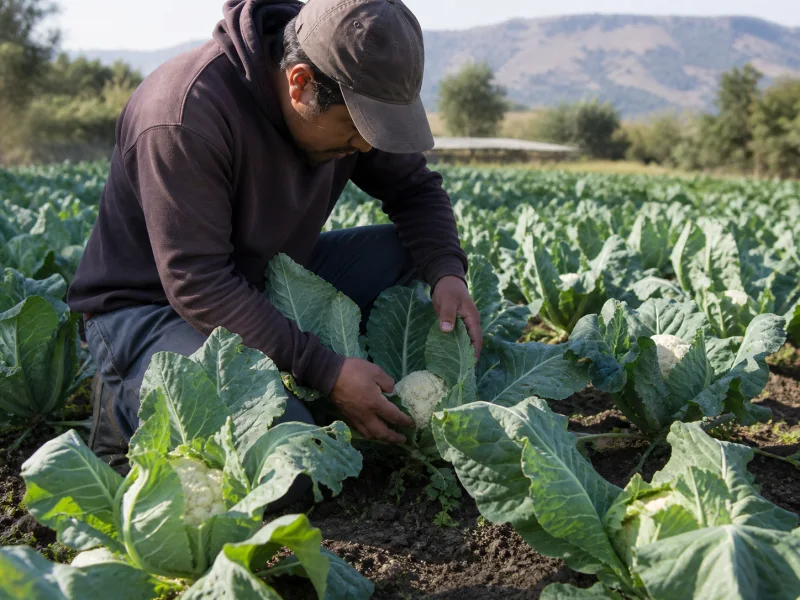
The outer leaves are part of the plant's working environment. They frame the curd, catch light and weather, and make each plant look more closed or open depending on its stage. A good check begins by making a small viewing window with the hands, then letting the leaves return to their natural position unless there is a clear reason to do more.
Look at the curd and the leaves together
Choose a few plants across the bed rather than relying on the most visible head near the path. Gently part the outer leaves and notice whether the curd looks compact, whether its surface is still clean enough to read, and whether the leaves around it are lying naturally or pressing in from one side. One plant is a clue; several plants reveal the pattern.
This comparison matters because cauliflower development does not move in a perfectly even line across every bed. Small differences in plant position, light, soil and earlier growth can make one head look ahead of another. The aim is to notice the difference without forcing all plants to look alike.
Do not turn a check into repeated rearranging
Once a curd is easy to see, it can be tempting to keep opening the plant for a better view. Repeated handling can make the next visit harder to compare because the leaf position has changed for the observer, not for the crop. Use a consistent, light touch: open a small window, look, and let the plant settle back.
If leaves or loose material are genuinely blocking the view, address only what prevents an ordinary check. The goal is a curd and leaf structure that remains readable at the next walk, not a field that has been adjusted to look identical from above.
Keep the path to the next observation
A cauliflower field is easier to manage when the same selected plants can be found again without stepping into the row. Mark the observation in your own routine by using a recognizable row position, a field edge, or a natural sequence of plants. That gives later checks a real comparison point.
- Open only enough leaf area to see the curd.
- Compare several plants before drawing a conclusion.
- Notice how the outer leaves sit as well as how the curd looks.
- Leave the plant in a state that the next visit can still read.
For cauliflower, careful observation is often more useful than constant adjustment. A small leaf window keeps the curd visible while allowing the rest of the plant to keep doing its ordinary work.