Once bitter melon vines climb the trellis, the main problem is often not weak growth. It is that the canopy fills too quickly. When the trellis becomes too dense, fruit is harder to see, harvest is delayed, flowers are harder to track, and fruit size becomes less even.
The existing bitter melon guide on leaving harvest access before the trellis fills in focuses on early structure. This article moves later: how to keep the trellis open enough for airflow, visibility, and repeated harvest after vines begin to close the canopy.
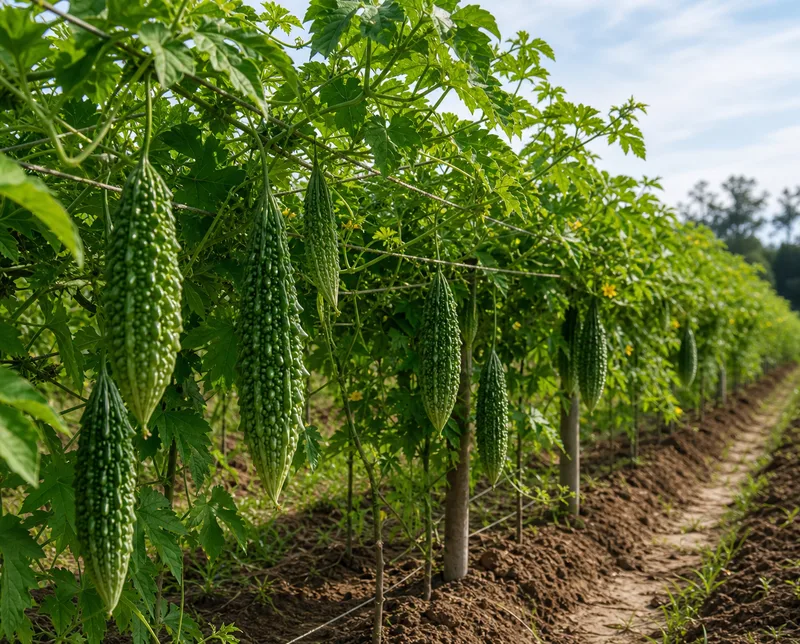
Protect the picking path before judging leaf volume
Bitter melon vines grow quickly. A trellis can look strong while it is quietly blocking the path, posts, and corners that make harvest possible. More leaves may look productive, but if fruit is hidden or hard to reach, quality becomes harder to control.
Start by checking how someone will walk, where hands can reach, and where fruit is most likely to be missed. Main paths, edge rows, and trellis corners should not be sealed completely. In bitter melon, the ability to keep picking at the right stage matters as much as vine vigor.
Open a dense canopy in stages
Bitter melon still needs leaves to feed fruit, so heavy pruning all at once is risky. A steadier approach is to remove old leaves, weak leaves, low leaves, and badly overlapping vines first. Then wait and see how light, air, and fruit exposure change.
If the canopy is opened too aggressively, fruit may be exposed suddenly and the plant can lose too much leaf area. Staged work keeps enough canopy to support new flowers, young fruit, and sizing fruit while still reducing the parts that are too dark or crowded.
Hidden fruit usually means late harvest
Bitter melon does not have an unlimited harvest window. Fruit hidden deep in the canopy is often picked late, not because harvest was ignored, but because the fruit was difficult to see. Late picking can affect texture, fruit appearance, and the plant's next flowering rhythm.
Harvesting well is not only about looking harder. The fruiting zone should be readable before harvest begins. Hanging position, leaf cover, trellis height, and picking direction all matter. This is similar to cucumber harvest gaps, where vine training and airflow shape picking rhythm.
Water and airflow need to work together
When bitter melon is flowering and fruiting continuously, moisture should be steady. But if the canopy is already humid and closed, simply adding more water can make the growing space harder to manage. Roots need moisture, while flowers, leaves, and fruit need air movement.
This also connects with watermelon fruit set, where moisture and fruit position need to be judged together. Vine crops rarely respond well when water, canopy, fruit position, and harvest timing are treated as separate problems.
Harvest records can reveal trellis problems
If one section of the trellis often has missed fruit, overmature fruit, smaller fruit, or fewer new flowers, do not blame only weather or variety. Check whether that section is too dense, hard to enter, poorly ventilated, or carrying too much load on a few vines.
Late bitter melon management is about keeping the trellis visible, reachable, and breathable. More foliage is not always better, and an overly open canopy is not the goal either. The useful balance is a trellis where fruit can be seen, picked on time, and supported by vines that are not overloaded.