Passion fruit vines can move from “not full enough” to “too dense to inspect” very quickly. A full trellis may look productive, but once flowering begins, the important question changes: can flowers be seen, can pollinators move through the canopy, and can fruit be found without pulling the vine apart?
For leader training and early trellis structure, start with the main passion fruit growing guide. This article looks later, from flowering into harvest, when trellis access, fruiting laterals, and ripeness checks become the work that keeps the crop manageable.
Flowers need light and access, not just more leaves
After flowering begins, do not judge the vine only by how much of the trellis is covered. Flowers hidden under a heavy leaf layer are harder to inspect, and the canopy can hold more humidity than the vine needs. Dense growth can also make it harder for pollinating insects to move through the trellis.
When tidying the canopy, keep laterals that are visible, well placed, and easy to follow. Remove or shorten shoots that cross heavily, bury flower positions, or make the trellis impossible to read. The idea is similar to the grape canopy and cluster load guide: the goal is not maximum leaf volume, but a canopy where flowers and fruit can function.
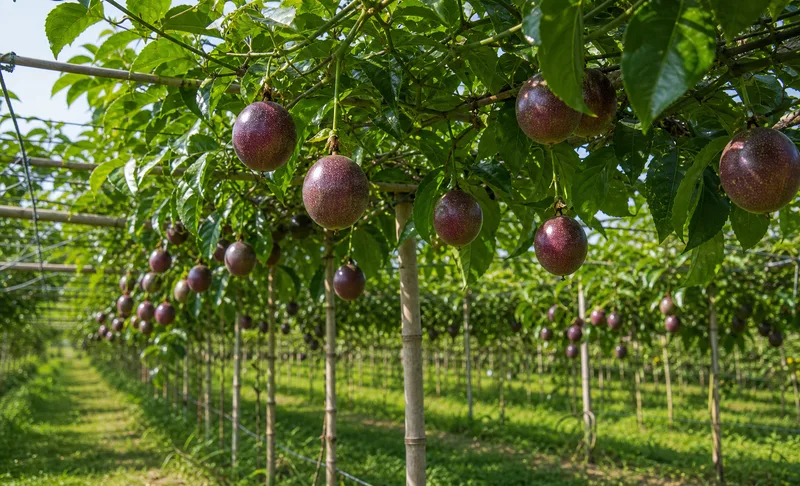
Too many hidden laterals can turn into missed fruit
More fruiting wood does not always mean an easier harvest. If laterals overlap heavily, fruit can develop in places that are difficult to see or reach. Early in the season this looks like strong growth. Later, it can mean uneven fruit size, scattered ripening, and mature fruit left behind in the canopy.
Sort the trellis mentally into three areas: laterals with good light and access, shaded laterals that are hard to inspect, and tangled sections that slow every harvest pass. Keep the first group working. Simplify the second and third groups before they become a picking problem.
Flowering and fruit set need steady moisture and air movement
Passion fruit does not respond well to sharp swings during flowering and fruit set. A dry root zone can slow the vine and stress flowers. A damp, closed canopy can make inspection harder and leaves the trellis feeling heavy. Watering should follow soil condition, weather, and vine load rather than a fixed calendar rhythm.
This is where passion fruit shares a management lesson with other trellised crops. The bitter melon trellis guide is about a different crop, but the same practical rule applies: once a vine fills the support, air and harvest access have to be protected.
Ripeness checks work better as a routine, not a rescue
Passion fruit usually ripens in waves. Waiting for the entire trellis to look ready is not a good plan. Check fruit color, surface change, aroma, and whether mature fruit is dropping or hiding inside the canopy. Fruit picked too early may not have the flavor you expect; fruit left too long may simply be missed.
Every harvest pass should also be a trellis check. Look for the next flowers, developing fruit, and any section that is becoming too dense. A clear trellis lets you see the current crop and the next crop at the same time.
A simple trellis walk-through
Start with the walking route. Then check whether flowers are visible. Look at fruiting laterals and remove the sections that hide too much. Finally, check mature fruit and the next wave of young fruit before leaving the row.
The point is not to keep the passion fruit vine sparse. It is to keep it readable. When flowers, fruit, airflow, and harvest access all have space, the crop is easier to manage and less likely to leave good fruit hidden in the canopy.