Dragon fruit can look orderly from the end of a row while the working area around each support post is becoming harder to read. After flowering, young fruit, new branch growth, ties, and older hanging segments can all collect around the same crown. The useful question is not whether the post looks full, but whether you can still see what is carrying fruit and reach it without pulling the plant apart.
A short inspection routine after flowers have set gives the crop a clearer structure. It helps separate the branches that are supporting the next fruiting cycle from the pieces that are only adding congestion, and it makes later harvest checks much less disruptive.
Read one support post before making any cut
Stand back far enough to see the whole post, then trace the main branches from the crown outward. Look for young fruit that is hanging clear, branches that are providing the canopy above it, and sections where several tips are competing in the same small space. This first look prevents an easy mistake: removing a branch simply because it is long when it is actually holding the most useful fruiting position.
Keep the decision modest. If one branch crosses directly over a young fruit or blocks the approach to it, redirect or remove that obstruction. If the branch is only slightly untidy but still leaves the fruiting zone visible, observation is usually more valuable than an immediate cut.
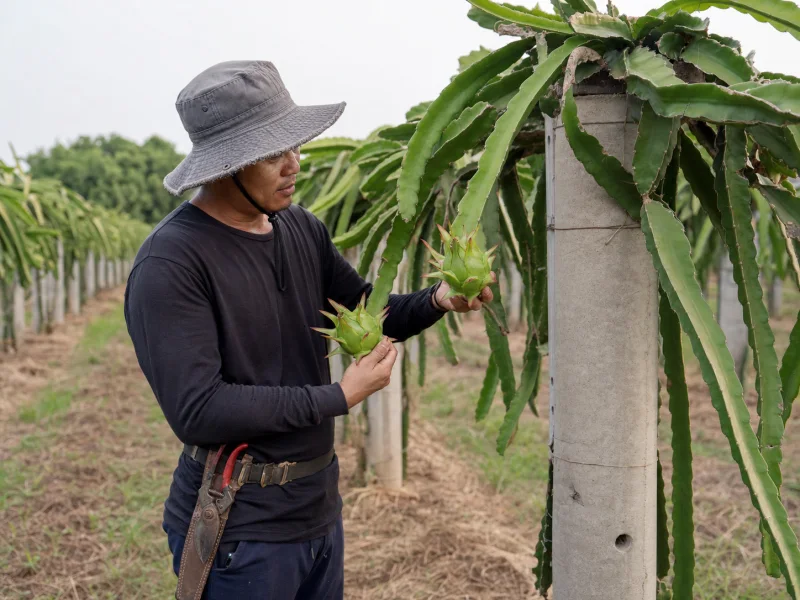
Keep young fruit hanging where it can be checked
Young dragon fruit is easier to follow when it hangs clear of tight branch clusters, support wire, and rubbing surfaces. During a normal walk through the row, notice whether a developing fruit can still be seen from the picking side and whether its supporting segment is under strain. If a segment has shifted, adjust the support around the branch rather than handling the young fruit repeatedly.
This is a different support system from a climbing vine, but the access principle is similar to the one in this luffa trellis and harvest access guide: the structure should make the crop easier to observe, not merely hold more growth.
Separate useful renewal growth from a crowded crown
New growth is part of the next cycle, so it should not be treated as waste simply because it appears near fruit. The practical distinction is whether a new segment has a clear route and leaves enough light and access around the post. A useful renewal branch can be guided into an open direction; several weak or overlapping tips in the same narrow zone usually make the crown harder to inspect.
Work one post at a time. Clear only the growth that clearly hides fruit, rubs persistently, or makes the support zone impossible to read. This avoids turning a routine inspection into a uniform pruning pattern that ignores how each plant is carrying its current load.
Use the post as the center of water and access checks
The base of a dragon fruit support post is also where small problems become easy to miss. After rain or irrigation, check whether water is moving away cleanly, whether the walking side is still firm enough to approach, and whether lower growth has begun to block the view of the support. The goal is not a perfectly bare base; it is a place where the plant and the row can still be checked without disturbing fruiting branches.
For another example of keeping a fruiting crop workable through repeated checks, compare the observation routine in this passion fruit flowering and harvest guide. The crop is different, but both benefit when the fruiting area remains visible before it becomes a harvest problem.
Make the next visit easier than this one
Before leaving a post, ask one final question: will the next person walking the row be able to see the new fruit, the supporting branch, and the open route in a few seconds? If not, make one small correction now. A redirected segment, a restored access lane, or a removed overlap often does more for the next inspection than a major reshaping.
That repeatable approach keeps the work grounded in what the plant is actually carrying. The post remains a clear fruiting station rather than a dense cluster that only becomes understandable when it is time to harvest.