A blueberry harvest can lose its rhythm long before the bushes run out of fruit. The usual problem is not simply finding ripe berries. It is allowing a full container to wait in a sunny row while the next bushes are picked, so the earliest fruit carries the longest stretch of field heat.
A more useful approach treats the harvest as a series of small handoffs. Pick a manageable tray, keep it shallow, move it promptly to shade or the next protected step, then return to the row. The work stays calmer, and the fruit is less likely to be buried under the weight or warmth of the next pass.
Begin with the berries that release cleanly
Walk the row with enough time to look through a cluster rather than stripping every berry that looks dark at a distance. A ripe blueberry should separate with a light touch; one that resists can be left for the next pick. Colour is a useful signal, but the crop does not become uniformly ready at the same moment, even on one bush.
That small decision keeps the container more even and avoids turning a harvest into a sorting problem later. It also makes the next visit to the same row more readable, because the berries left behind have a clear reason for still being on the plant.
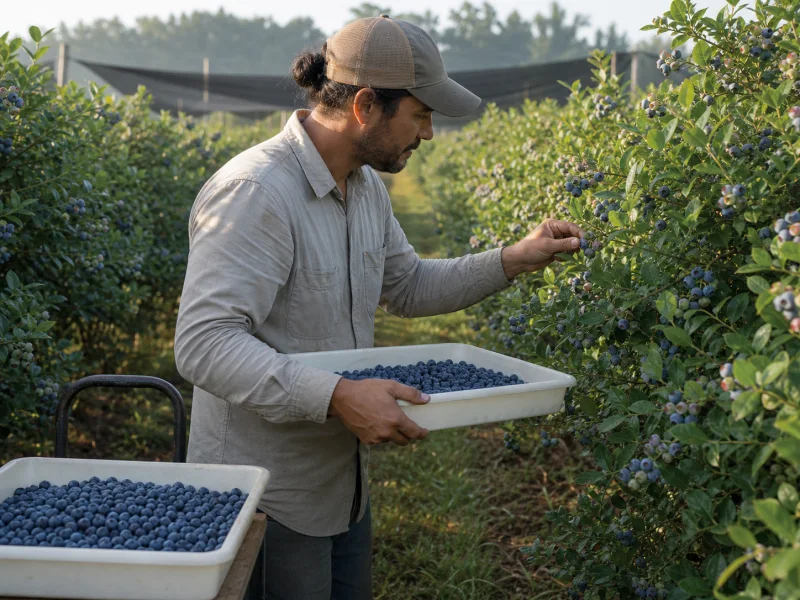
Use a shallow tray as part of the quality check
A shallow, clean container gives the berries room to stay in a light layer instead of carrying the weight of a deep pile. It is not only a packing choice. While picking, the tray lets you notice soft fruit, leaves, or a few unripe berries before they disappear under the next handful.
Keep the tray steady and avoid pouring berries back and forth between containers in the field. When a tray is ready to move, use that moment as a natural break: set it in shade, send it to the collection point, or place it in the next protected transport step before beginning another section.
Give the row a short route to shade
Ripe berries do not need a complicated journey, but they should not wait beside a hot path simply because the harvest is continuing. Before starting, identify the nearest shaded cart, covered table, or collection point and make sure it can be reached without crossing through several unpicked rows. The best location is the one that will actually be used every time a tray fills.
This is a harvest workflow, not an invitation to rush. A shorter route to shade means pickers can keep their attention on fruit selection rather than deciding where a full tray should go. In other crops, the same field-heat handoff is visible in this summer lettuce harvest and cooling guide; blueberries need their own gentler handling, but the early move away from heat has the same purpose.
Let each tray show what the block is doing
As trays come in, look for a simple pattern rather than trying to judge the entire block from one attractive bush. Are ripe berries concentrated on the sunny side? Is one section yielding a mix of sizes because it needs another day? Are soft berries appearing only near a particular edge of the row? These small observations help decide where the next picking pass should begin.
The sampling principle is similar to the one used when deciding a grape harvest window: one especially advanced cluster does not represent the whole planting. The grape sampling guide uses a different crop, but the practical habit is the same: collect evidence across the row before treating one spot as the answer.
Finish the pick with an orderly handoff
At the end of a pass, leave the row in a state that makes the next pass obvious. Full trays should already be out of direct sun. Part-filled trays should not be left on soil or beneath dripping foliage. Record or remember which section was ready, which was mixed, and which should be returned to later.
That is enough structure for a productive day. The aim is not a rigid harvest schedule; it is a repeatable sequence that keeps ripe fruit visible, handled lightly, and moving toward protection while the berries are still at their best.