The seed rack offers bush beans and pole beans, both promising tender green pods. The useful question is not which is better. It is which one fits the place you can give it and the way you will actually pick the crop.
A short row with no permanent structure suggests one answer. A narrow bed beside a sturdy trellis suggests another. Before buying seed, picture yourself harvesting there: can you reach the plants, and will you return often enough?
First, make sure you are comparing the same crop
This comparison is about common snap or French beans, Phaseolus vulgaris, harvested for their tender pods. Bush and pole describe growth habit, not pod colour. Yellow wax beans and purple-podded varieties can also belong to this crop. Runner beans and yardlong beans are different species; a packet marked simply “climbing beans” deserves a closer look. The University of Minnesota's bean guide distinguishes these groups.
Read the variety name, growth habit and intended harvest together. A beautiful climbing dry bean is not automatically the right substitute for a snap bean you expect to pick young. Save the packet: it will be more useful than a generic spacing chart when you lay out the bed.
What changes when the plants climb?
Bush beans stay comparatively low and normally need no climbing frame. Pole beans make long twining stems and need a secure support. As a rough scale, the Iowa State green-bean guide describes bush plants around 30–60 cm (1–2 ft) high and pole-bean supports around 1.8–2.1 m (6–7 ft). These are not universal dimensions for every cultivar.
That difference changes the job as much as the footprint. With bush beans, consider how you will reach low pods without stepping into the bed. With pole beans, stand beside the proposed frame and check both the far side and the highest picking point. A trellis that fits on paper can still be awkward against a wall or behind another crop.
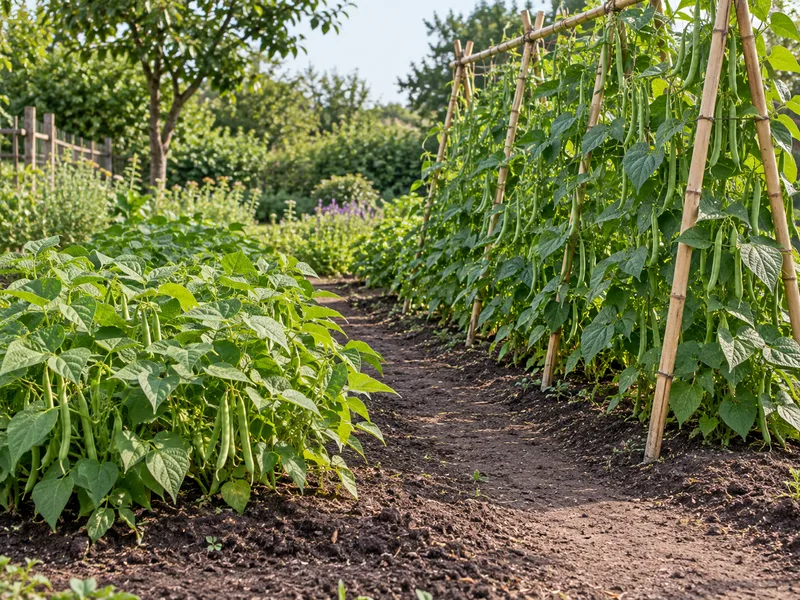
Install the climbing structure before sowing, rather than pushing poles through established roots later. When planning picking access, the yardlong-bean guide to keeping pods visible offers a useful layout comparison. Its crop is different, so use the access principle, not its bean-specific growing schedule.
A concentrated crop or a longer picking season?
Bush beans tend to deliver a more concentrated harvest; pole beans generally keep producing over a longer period when conditions remain suitable and pods are picked regularly. The RHS French-bean guide makes this distinction. It does not mean a bush plant yields everything in one afternoon or a pole plant produces indefinitely.
For a household that wants several larger picking sessions, a bush planting may be convenient. For someone who likes collecting small amounts repeatedly, a pole planting may fit better. Neither option turns ripe pods into a crop that can wait until a distant free weekend. Judge harvest readiness from the pods, not your calendar.
Repeated small sowings can extend a bush-bean crop, but they need both spare ground and enough suitable growing time. Iowa State suggests intervals of two to three weeks; its final sowing dates apply to Iowa, not every reader's climate. Before sowing another batch, compare the packet's maturity estimate with your local remaining season.
Three garden situations, three reasonable choices
- A bed needed for another crop later. Consider a compact bush variety and a clearly defined planting area. Write down when the space must be available again; do not assume an exact clearance date from the words “early variety.” Weather can change the timetable.
- A narrow strip with a sound existing frame. Consider pole beans, provided there is sunlight, root space and access. Measure the usable bed, not just the fence length, and account for where the leafy frame will cast shade.
- A first attempt with room to compare. Grow a modest amount of each in separate labelled sections. Record first picking, time spent harvesting and whether the crop suits your meals. That gives you a useful local comparison instead of an unsupported claim that one type always wins.
If the real constraint is reaching the crop, redesign access before deciding how many seeds to sow. Putting more plants into the same inaccessible corner only increases the amount of crop you may miss.
What does not change with the choice
Both need a suitable warm growing window and soil that drains well. Do not transfer a regional spring or autumn sowing month into a different climate. Check local frost risk, soil conditions and the variety's instructions. A sunny afternoon alone does not establish that the bed is ready.
Mark the intended planting positions, water access and walking route before opening the packet. Leave the path as a path: it is part of the productive layout, not wasted space waiting for extra plants. When arranging neighbouring crops, the vegetable planting and harvest collection can help you think through their different jobs and timings.
The choice is successful when the support, picking routine and next use of the bed agree. You do not need the tallest bean or the largest possible planting. You need a crop you can comfortably look after and harvest.