There is a tempting moment with kohlrabi: the rounded stem is finally big enough to notice, but you leave it another week because a larger harvest seems like a better harvest. Sometimes it is. With an ordinary small-stem variety, however, the extra size may cost the crisp texture you were waiting for.
The useful question is not simply how many days have passed since sowing. It is which variety you planted, how wide its swollen stem has become, and whether a peeled sample still has the texture you want. Those three checks give you a more workable harvest decision than comparing leaf height across the bed.
The round part is a stem, not a root
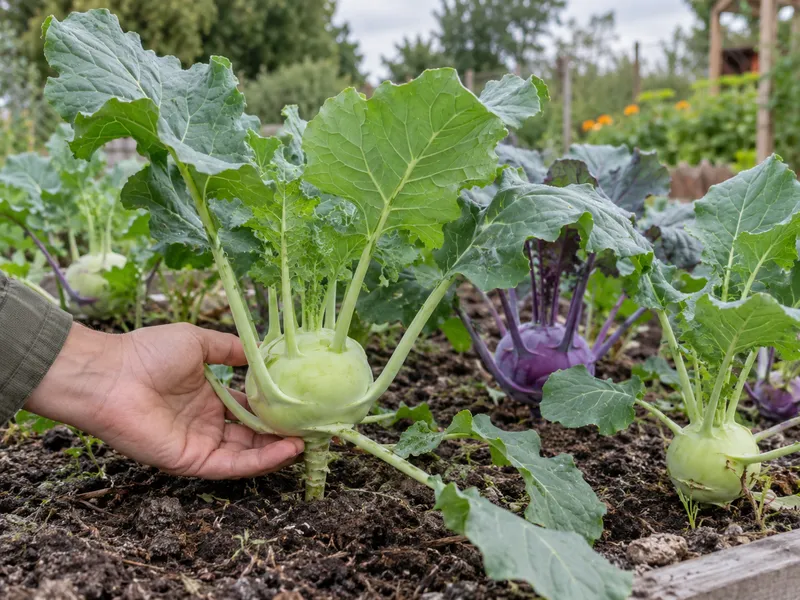
Kohlrabi looks a little like a turnip lifted out of the ground. Its edible rounded portion is actually an enlarged stem that develops just above the soil, with leaf stalks attached around it. You do not need to dig a deep hole to find the harvestable part. Illinois Extension's crop description explains this useful distinction.
Measure across the widest part of that stem, excluding the projecting leaf stalks. A small ruler is easier to compare from one visit to the next than a remembered “tennis-ball size.” Leave the plant in place while measuring, and look at more than the largest specimen. A row sown on the same day can still contain plants ready to cut and others worth leaving.
Small-stem and giant varieties have different finish lines
For many common varieties, a stem about 2–3 inches (roughly 5–8 cm) across is a useful starting harvest range. Utah State University's kohlrabi fact sheet uses that range and warns that larger, older stems tend to become woody. It is a practical starting point, not a guarantee that every plant at exactly the same diameter has identical eating quality.
Giant varieties are a separate case. University of Minnesota Extension describes giant types grown to substantially larger sizes and notes that cooler fall conditions can allow better quality at a larger size. Check the variety's own harvest guidance before cutting a giant type according to a small-variety rule. If the seed packet has gone missing, use an early sample to judge texture rather than assume every large stem has failed.
Green and purple skin are not two stages of ripeness. They are variety characteristics. In a mixed planting, label the varieties and assess each on its own terms. A purple stem does not need to turn green, nor should one color be left longer merely because the other was ready first.
| What you know | What to do next |
|---|---|
| A common small-stem variety is approaching its recommended size | Harvest one sound specimen and check the peeled interior. |
| The packet names a giant variety | Use its own size guidance; do not impose a small-variety limit. |
| The variety is unknown and stems are enlarging rapidly | Sample now and decide whether the remaining plants should be picked soon. |
Cut one open before waiting for a bigger row
Select a sound plant that represents the size you are considering, rather than the one with the most obvious damage. Harvest it by cutting at ground level with a clean, sharp tool, or lift the whole plant and trim the root and leaves. Both methods are described in extension guidance. Support the stem while cutting so the tool does not slip toward your other hand.
For an eating-quality check, wash the harvested stem and peel away the outer skin. Cut through the lower portion as well as the upper part. Notice whether a knife moves cleanly through crisp flesh or encounters coarse, stringy tissue. Illinois Extension notes that older stems can become particularly fibrous lower down; a tender slice from the top alone can give an incomplete impression.
The peel is naturally tougher than the interior. Do not reject a sound stem merely because its skin needs removing. Equally, do not expect a thick peel to explain away fibrous tissue that continues through the flesh. Use this sample to choose the next harvest pass. It is a kitchen check of the crop you have, not a diagnosis of why every plant in the bed grew differently.
Heat and uneven moisture narrow the choice
A stem can reach a suitable size yet lose quality under difficult growing conditions. Heat and moisture stress are recognized contributors to poor kohlrabi texture. The University of Saskatchewan's guide recommends cool growing conditions and checking the seed package for the correct mature size. Neither the calendar nor diameter should overrule what you find in a representative sample.
When a warm spell arrives, inspect a ready-size planting rather than postponing everything until the weekend. Water according to moisture in the root zone, rainfall and drainage. A dry-looking surface alone does not establish that the whole bed needs soaking, and extra water will not turn already woody flesh tender again. Keep growth as steady as the site allows; avoid alternating prolonged dryness with a large catch-up watering.
If the next crop starts in trays, keep the variety labels with the plants and do not confuse a large leaf canopy with a uniform batch. The way we group a broccoli tray before transplanting offers a useful approach to sorting vigorous and lagging brassica seedlings, so slower plants are noticed before they disappear among larger neighbors in the bed.
Bring the harvest indoors as two separate foods
Remove the leaves for storage and keep the sound stems in the refrigerator in a perforated produce bag. Use the leaves separately and sooner. Iowa State's harvest and storage guidance describes refrigerated storage for up to about three weeks under suitable conditions. Treat that as a possible storage period, not a promise: inspect your own batch and use damaged or deteriorating produce appropriately rather than counting days alone.
This is a different storage job from the dry, ventilated curing used for onions before storage. Leaving harvested kohlrabi on a curing rack to dry its skin is not a substitute for refrigeration. Keep the crop's identity with its storage instructions, particularly when several vegetables come indoors on the same day.
Before the next cut: confirm the variety, measure the swollen stem rather than the leaves, check a peeled sample, and have cool storage ready. Once that sample is crisp and the stems are at the variety's useful size, more weight is not automatically a better reason to wait.