Luffa can look easy once the canopy has covered a trellis. The harder part is building a support system that still works after the vines become heavy, fruit begins hanging at different heights, and picking needs to happen often without pulling the whole plant out of position.
This guide treats the trellis as a working surface, not a backdrop. The aim is to give each main vine a clear route, keep young fruit visible and hanging freely, and leave enough access to make small corrections before the canopy becomes crowded.
Build the support before the vine asks for it
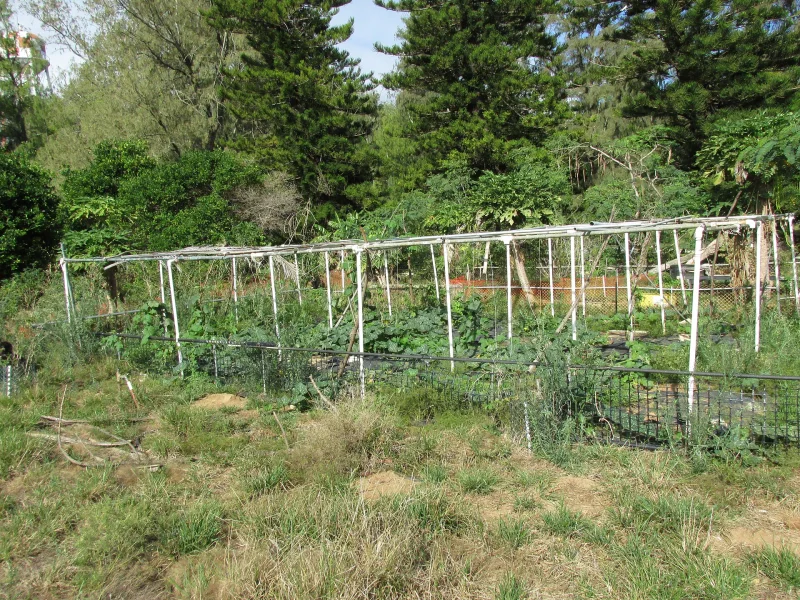
A luffa trellis needs to carry more than leaves. Mature vines, wet foliage after rain, and a run of developing fruit can all load the same section at once. Use posts and crosspieces that do not flex easily, then add lines or mesh tightly enough that a vine can be guided without the whole panel sagging toward the path.
Keep the lowest tie points and the base of each plant easy to reach. That simple access matters later, when a leader needs redirecting or a damaged leaf needs removing. The useful principle is similar to the one in this bitter melon trellis and airflow guide: a support should open the canopy for people as well as for light and moving air.
Give the first leaders separate lanes
Do not wait until several stems are tangled before choosing a direction. As the first strong leaders reach the trellis, guide them into different lanes and tie them loosely enough that the stem can thicken. A vine that crosses back and forth may still grow, but it makes later pruning, checking, and harvest slower.
Look down the row from both ends. If two leaders are aiming for the same narrow space, redirect one while it is still flexible. The best layout is not necessarily perfectly symmetrical; it is one where you can see where each vine begins, where it is carrying fruit, and where a stem can be reached without stepping through the planting bed.
Keep side shoots useful, not merely short
Side shoots are not automatically a problem. Some fill an empty section of trellis and can carry useful leaves and fruit. Others turn into a dense knot around the same point, shading young fruit and making the plant difficult to inspect. Decide shoot by shoot according to the space available, rather than cutting everything to one uniform pattern.
When a section is already crowded, remove the weak, inward-growing, or overlapping shoot first. When a section is open, guide a healthy side shoot into unused mesh instead of forcing all growth onto the original leader. This is maintenance by observation: the question is whether the shoot improves the working canopy, not whether it follows a fixed count.
Let young fruit hang clear of leaves and wire
Straight, tender luffa fruit is easier to pick when it can hang freely and be seen at a glance. Check that a developing fruit is not trapped against a tie, wire, or a cluster of leaves. If a vine has shifted, move the supporting stem rather than handling the young fruit roughly.
After rain or a deep watering, walk the row once the foliage has settled. Heavy leaves can cover fruit that was visible the day before, and a sagging section may place fruit against the ground. Root-zone management also affects how manageable the canopy becomes; the practical checks in this cucumber vine, water, and harvest guide are useful when you are trying to keep a long-season climbing crop reachable without soaking the bed repeatedly.
Treat harvest as a daily canopy check
Luffa for fresh eating is best picked while the fruit is still tender. That means harvest is not a task to postpone until the row looks full. Frequent picking keeps oversized fruit from hiding among leaves, and it gives you a regular chance to notice broken ties, crowded shoots, or fruit that needs a clearer path.
Carry the same routine through the season: harvest what is ready, look for fruit that is beginning to disappear into foliage, then make one small support or training correction before leaving the row. A strong trellis and a visible canopy do not make luffa maintenance automatic, but they keep the daily decisions simple enough to repeat.