Picking apricots changes what the orchard gives back to the person looking at it. Fruit that had been tucked among leaves is gone; a branch that seemed crowded now has a visible shape; a spot that was easy to reach may show where the harvest work concentrated. That clearing is not a sign that the season has nothing left to say. It is a brief chance to see the tree without its crop hiding the structure.
This is a post-harvest review, not a recipe for changing everything at once. The useful work is to connect what happened while picking with what can now be seen in the canopy, then leave the next decision tied to a real observation rather than a habit.
Start at the crates, then turn toward the trees
Before a crate is emptied or the harvest day is forgotten, notice what it records. Did fruit from one part of the row need a separate pass? Were some branches easy to reach while others were repeatedly skipped until the end? Were there areas where the person picking had to stop and change position? These are practical details about the tree as well as the fruit.
A simple note can hold the row, a recognizable tree, and one harvest observation. It does not have to sort every apricot into a score. Its value is that the same point can be checked once the fruit is no longer drawing all the attention.
For example, a row that filled crates steadily but required awkward reaching tells a different story from a row where fruit was easy to pick but unevenly distributed. Neither observation is automatically a fault. Together, they describe the working relationship between the person, the fruit, and the permanent shape of the tree. That is more useful than a vague memory that one row was simply "good" or "difficult."
See what the fruit had been hiding
After harvest, stand back far enough to see the spaces that the crop used to fill. Look at how the main branches divide, where foliage has become dense, and where a thin or awkward section had been obscured by ripe fruit. Move around the tree before treating the first opening as the whole answer. A gap from the path may look different from the same gap on the far side.
This is a viewing pass, not a reason to turn every visible branch into an immediate cut. The point is to separate a stable part of the tree's structure from the temporary appearance created by a full crop.
It also helps to compare two nearby trees that carried fruit differently. One may look open simply because it held less crop; another may have a genuinely clearer branch arrangement even after both trees are picked. Seeing that distinction prevents a gardener from copying the appearance of one tree onto the next. A useful comparison asks what stayed visible after harvest, what only became visible after harvest, and what still needs another visit before it means anything.
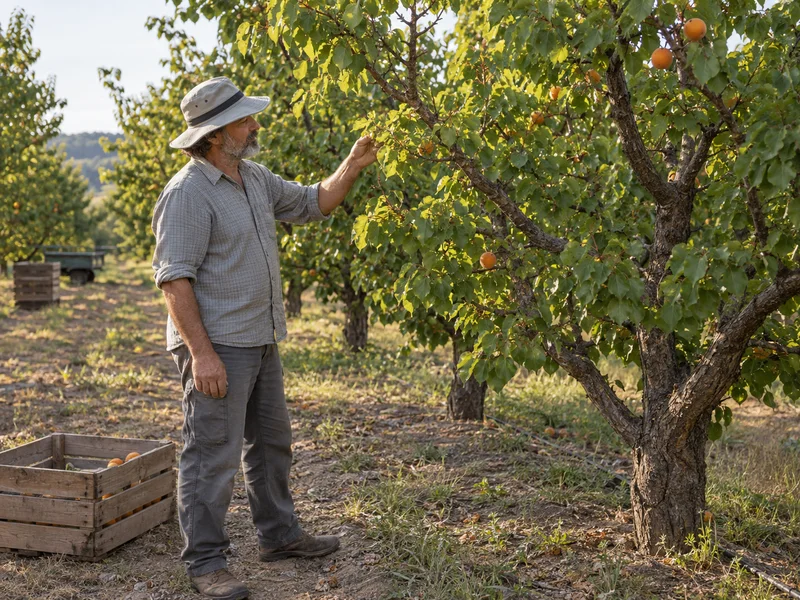
Read carried fruit and new growth in the same frame
Once a branch is no longer carrying fruit, its relationship to the surrounding shoots is easier to read. Some shoots may have a clear place in the canopy; others may occupy an already crowded section. Rather than deciding from length alone, compare position, direction, and the light available around the branch. The question is not whether every vigorous shoot is wrong. It is whether the tree will still be understandable and workable when another crop occupies the same space.
The post-harvest cherry guide looks at a related handoff: picking may be finished, but leaves, drainage, and canopy decisions remain part of the tree's season. Apricots call for the same kind of attention without assuming that two orchards need the same response.
Leave the next pruning decision open
A post-harvest review becomes more useful when it ends with a question rather than a rushed pruning order. It might be: which branch carried fruit well but was difficult to reach, where did the canopy close first, or which tree deserves a return visit before the next structural decision? That wording keeps the next action connected to the situation that prompted it.
Raspberry rows offer a useful contrast. In the raspberry cane renewal guide, spent canes and replacement canes can often be distinguished directly. An apricot tree is not that simple. Its next step benefits from retaining the story of the harvest, the newly visible branch pattern, and the time to make a measured decision.
Local weather, root-zone condition, tree age, and the fruiting pattern of a particular planting all affect what comes next. That is why this review deliberately stops before it turns into a universal schedule. A good note preserves what was visible on this tree, so later work can respond to the orchard rather than forcing the orchard to match a generic sequence.
- Keep one harvest observation with a row or tree reference.
- Review the canopy only after the crop no longer hides its shape.
- Compare branch position with the shoots around it.
- Record the next question before choosing the next intervention.
The result is not an orchard made uniform in one afternoon. It is an apricot tree whose next stage begins with a clearer record of what the previous crop revealed.